The story of Trump International Hotel and Tower
Three setbacks measured against Chicago's icons, a 1,388-foot spire, and the giant TRUMP letters that made it one of America's most argued-about buildings. Toggle between Detailed, the tower as opened in 2009, and Today.
The tallest tower that was not 2001
In July 2001 Donald Trump announced plans for the former Chicago Sun-Times site: a 1,500-foot tower that would be the world's tallest, with 2.4 to 3.1 million square feet of floor space. Three firms were considered; Trump selected Skidmore, Owings and Merrill in August 2001, with Adrian Smith, who had designed the Jin Mao Tower, heading the team, giving Chicago its third SOM skyscraper after the Willis Tower and Hancock Center. After the September 11 attacks, Trump cut the plan to 78 stories and 1,073 feet "to reduce the risk of similar attacks"; Time reported that a meeting between Smith and Trump about the tallest building in Chicago was taking place at the actual time of the attacks. Successive revisions followed, 86 floors in 2002 and 90 stories in 2003, ending with an ornamental spire replacing broadcast dishes, since dishes would not count toward height and the spire does. The final design height referenced the 1,362-foot height of the former 2 World Trade Center; the completed tower stands 1,388 feet tall.
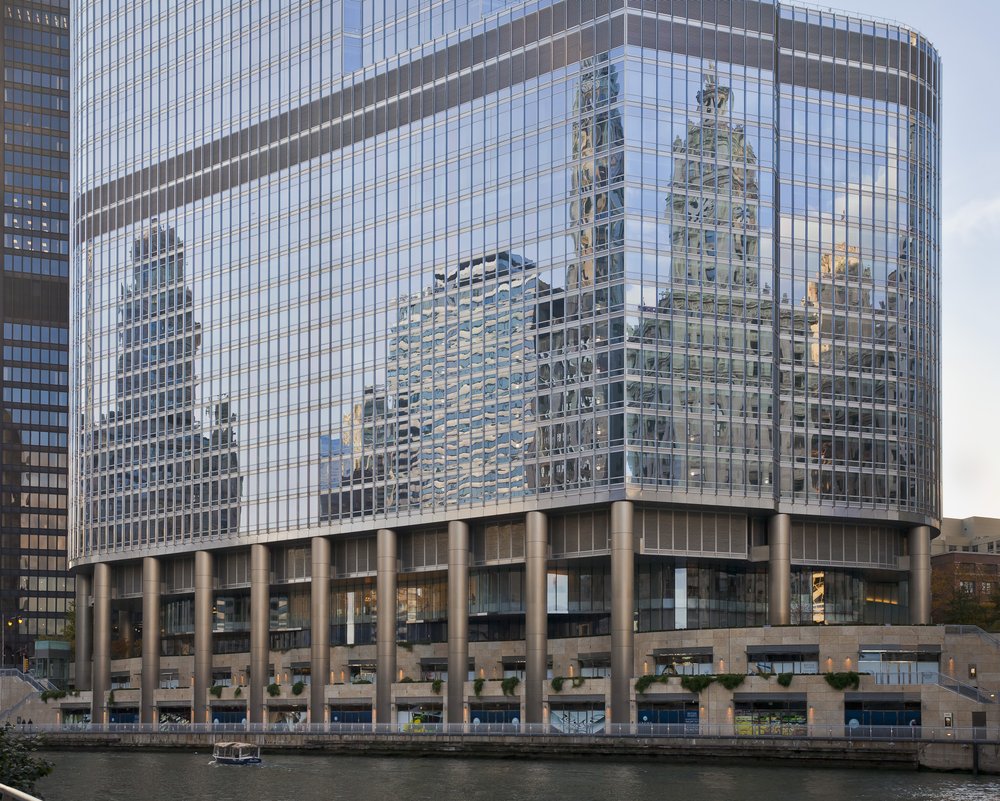 The full facade from the river side: 98 floors and 2.6 million square feet. Diego Delso, CC BY-SA 3.0, via Wikimedia Commons
The Big Pour 2004-2009
On 16 October 2004 Trump and Hollinger International completed the $73 million sale of the former Sun-Times building; demolition began on 28 October. Financing came from a $650 million loan from Deutsche Bank plus hedge funds, one backed by George Soros. Two earlier Sun-Times business decisions saved time and money: the 1950s sea wall was built to bomb-shelter thickness and survived, and a 1970s switch to soy-based ink reduced ground pollution and cleanup costs. In October 2005, 30 concrete trucks made 600 trips in 24 hours to pour 5,000 cubic yards of concrete for the 200-by-66-by-10-foot mat foundation, a day crews called the "Big Pour". The tower is cantilevered into 420-million-year-old limestone bedrock 110 feet underground on 241 caissons. Self-compacting concrete up to 16,000 psi was pumped to record heights; at completion it was the tallest formwork structure in the world. Spire sections were delivered by helicopter; the spire was completed on 3 January 2009, and the building and hotel opened on 30 January 2009.
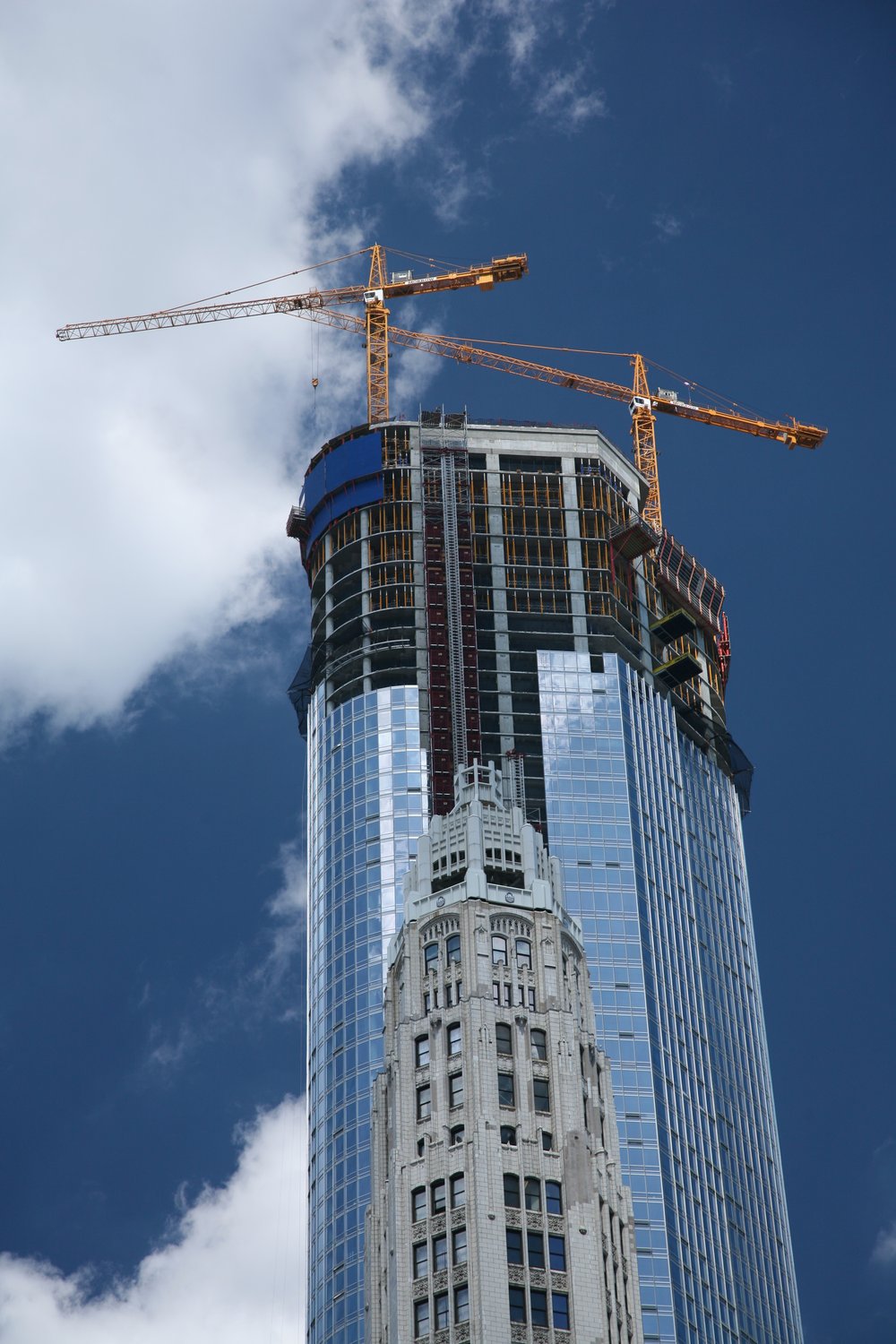 The tower under construction, before the 2009 completion. DanielSchwen, CC BY-SA 3.0, via Wikimedia Commons
Measured against the skyline 2005-2009
The tower's defining move is its three setbacks, which "provide visual continuity with the surrounding skyline, each reflecting the height of a nearby building": the first setback on the east side aligns with the cornice line of the Wrigley Building, the second on the west side aligns with River Plaza and the Marina City Towers, and the third on the east side relates to 330 North Wabash, formerly IBM Plaza. Rounded edges combat vortex formation. This is documented design intent: a modern tower literally measured against Chicago's 1920s icons. At 98 floors and 2.6 million square feet, the tower was the second-tallest building in the United States when topped out in 2009 and briefly held the world's highest residence, surpassing the John Hancock Center's record from 1969, until the Burj Khalifa.
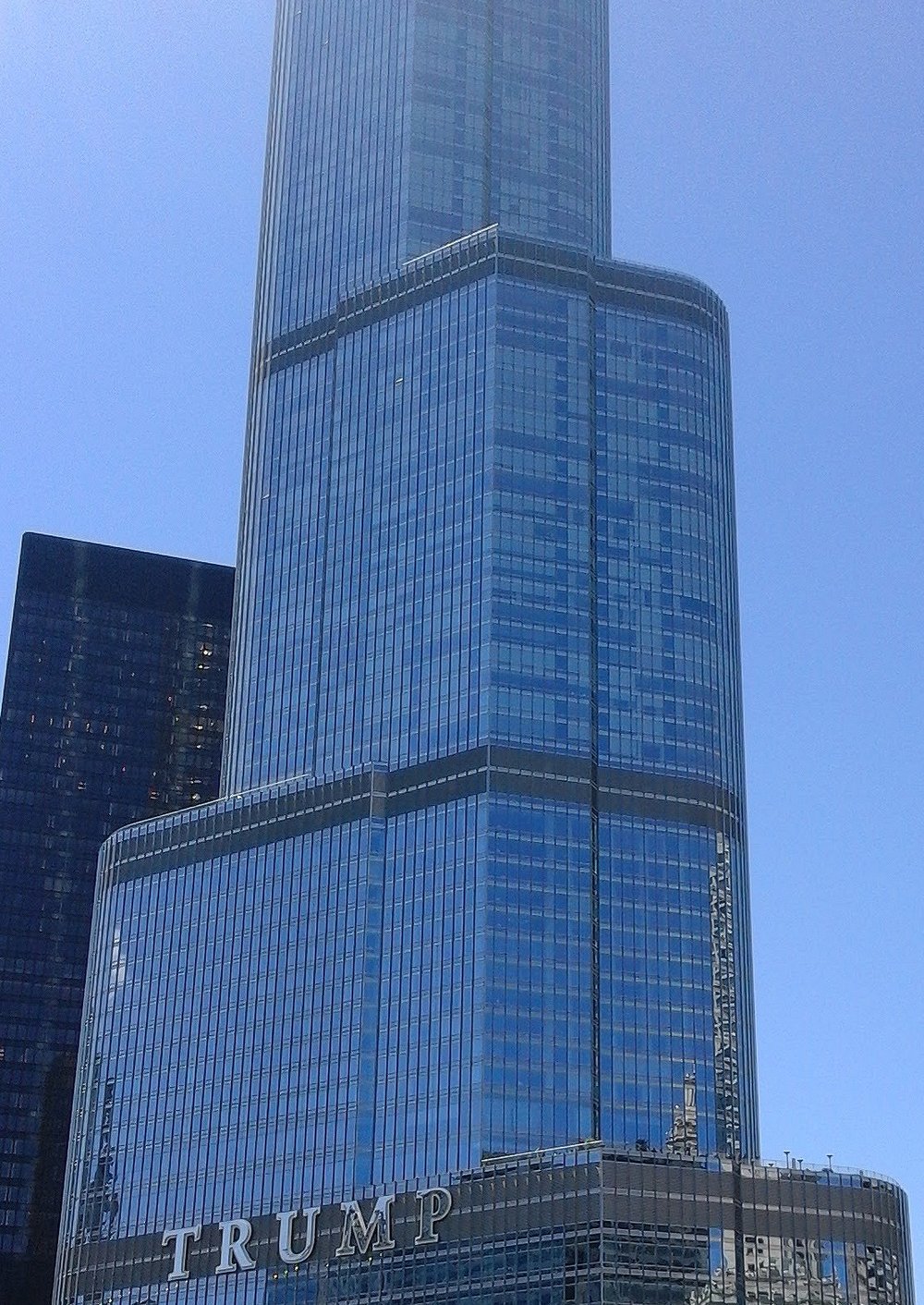 The tower with the Chicago River in the foreground. Spock1801, CC BY-SA 4.0, via Wikimedia Commons
The sign 2013-2014
In October 2013 Trump won approval for 20-foot-tall back-lit stainless steel letters on the 16th floor, spanning about 141 feet and roughly 2,800 square feet, installed in May and June 2014. Trump said: "As time passes, it'll be like the Hollywood Sign." Architect Adrian Smith distanced himself: "Just for the record, I had nothing to do with this sign!" Tribune critic Blair Kamin and Mayor Rahm Emanuel objected; Emanuel's spokeswoman said: "Mayor Emanuel believes this is an architecturally tasteful building scarred by an architecturally tasteless sign." Emanuel initiated a study of signage rules. One reading of this: the tower's story is inseparable from the brand, and the building functions as a billboard for its namesake.
Money fights and the name 2008-2024
In September 2008, as unit sales slowed in the subprime crisis, Trump sought to extend the Deutsche Bank and Fortress mezzanine loans. Deutsche Bank demanded payment including his $40 million personal guarantee; Trump sued in New York State Supreme Court citing a force-majeure clause and sought $3 billion in damages for alleged predatory lending. Deutsche Bank countersued. Both sides suspended litigation in March 2009; an amended loan agreement in September 2010 extended about $600 million for five years. Separately, Trump rescinded discounted "friends and family" condo purchases after values rose past $1,300 per square foot, prompting a lawsuit by former Sun-Times publisher F. David Radler. In 2024 the New York Times and ProPublica reported that the IRS was investigating whether Trump twice wrote off losses on the tower, with a potential new tax bill over $100 million; this is ongoing reporting, not a resolved case. Trump's 2016 presidential campaign slowed condo sales; real estate observers noted buyers hesitated to be associated with the Trump name. In June 2018 the Sierra Club, Friends of the Chicago River, and the Illinois Attorney General sued over the cooling-water intake that siphons river water, and on 9 September 2024 a judge ruled the intake a public nuisance in violation of Illinois environmental law.
Concrete, film, and river 2004-2020
The tower's construction fed pop culture. In 2004 the top construction-management job at the tower was the prize for the winner of the first season of The Apprentice; Bill Rancic chose the tower project and served as President of the Trump International Hotel and Tower. In summer 2007 the final Batman-Joker confrontation in The Dark Knight was filmed at the top of the partially completed tower, and the tower was a key location for Transformers: Dark of the Moon in 2011. The Sixteen restaurant held two Michelin stars in 2016 before becoming Terrace 16 Restaurant and Bar in 2018. Not all stories are glamorous: in February 2014 three intoxicated men set off fire alarms and opened a fifth-floor standpipe as a prank, flooding elevator shafts and causing about $700,000 in damage. On 18 October 2020 a man in his 20s suspended himself from the 16th floor and hung down the river-facing side for more than thirteen hours, livestreaming and demanding to speak to then-President Donald Trump; police resolved it peacefully.
In the cultural conversation 2011
The building's screen life is thin, and its one true starring role is in Transformers: Dark of the Moon (2011): the villain Dylan Gould's penthouse inside the tower is where Carly is held captive, and the rescue sequence plays out in and around the building as the Decepticons turn Chicago into a fortress. Beyond that it appears in Chicago skyline shots, and it has no presence in famous painted works.
Sources: Historical facts adapted from Wikipedia ("Trump International Hotel and Tower (Chicago)", CC BY-SA), New Civil Engineer ("Windy City Wonder"), the New York Times and ProPublica (IRS investigation reporting), and NPR Illinois. Cultural appearances verified against Wikipedia, BFI, museum collection pages, and production coverage.
Trump International Hotel and Tower from the river side, 2012: Diego Delso, CC BY-SA 3.0, via Wikimedia Commons
The tower under construction: DanielSchwen, CC BY-SA 3.0, via Wikimedia Commons
The tower with the Chicago River in the foreground: Spock1801, CC BY-SA 4.0, via Wikimedia Commons