The story of the Trevi Fountain
Oceanus rides his shell chariot out of a Roman palace wall, and three thousand euros a day land in the basin. Toggle between Detailed, the fountain as finished in 1762, and Today: the queuing system, the two-euro ticket, and a hundred LED lights.
Two thousand years of water 19 BC-1730
The Trevi Fountain marks the terminal point (mostra) of the Acqua Vergine, the revived Aqua Virgo aqueduct that has supplied Rome since 19 BC. Legend says a virgin showed Roman technicians a pure spring about 13 km from the city, and Marcus Vipsanius Agrippa built the aqueduct to supply his baths near the Pantheon; the scene is shown on the present fountain's facade. The aqueduct was damaged during the Ostrogoth siege under Vitiges in 537, but the Acqua Vergine stayed in use through the Middle Ages, with restorations attested in the 8th century and again by the municipality in the 12th century, when new sources near a place called Trebium were connected. In 1629 Pope Urban VIII, finding the earlier fountain insufficiently dramatic, asked Gian Lorenzo Bernini to sketch renovations, but the project died with the pope. Early designs also came from Pietro da Cortona, Nicola Michetti, Ferdinando Fuga, and Edme Bouchardon.
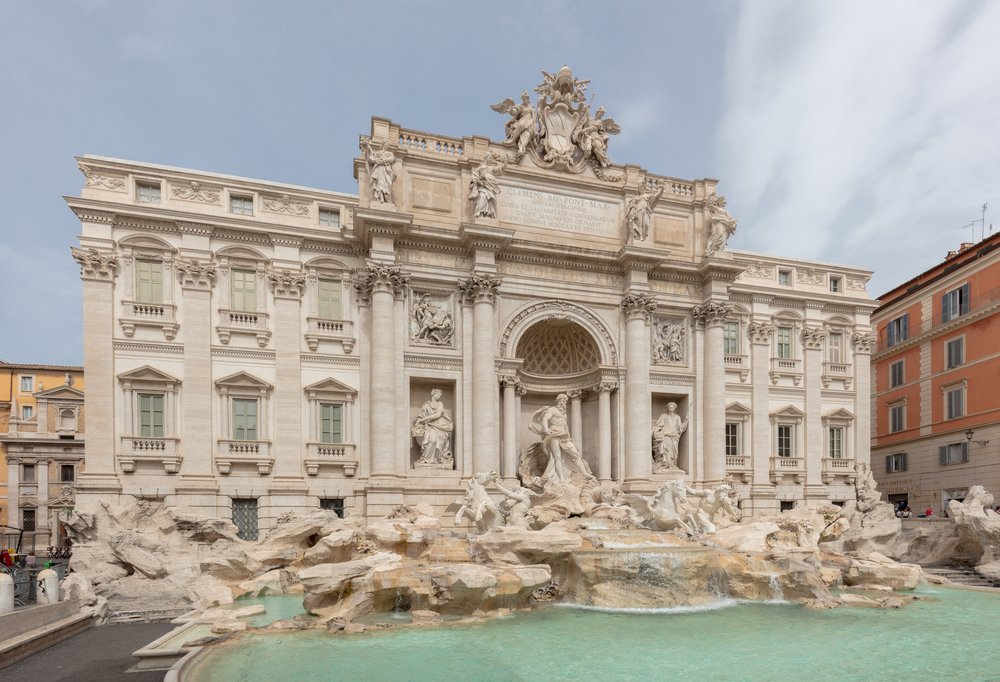 The full facade: 26.3 metres high and 49.15 metres wide, the largest Baroque fountain in the world. Diego Delso, CC BY-SA 4.0, via Wikimedia Commons
The competition and the outcry 1730-1762
In 1730 Pope Clement XII held a competition for the fountain. Nicola Salvi initially lost to the Florentine Alessandro Galilei, but the outcry in Rome over a Florentine winning led the pope to give Salvi the commission anyway. Work began in 1732. Salvi died in 1751 with the work half finished. Four sculptors completed the decoration: Pietro Bracci, whose Oceanus stands in the central niche, Filippo della Valle, Giovanni Grossi, and Andrea Bergondi. Giuseppe Pannini, son of Giovanni Paolo Panini, took over as architect and substituted the present allegories for the planned sculptures of Agrippa and Trivia, the Roman virgin. The fountain was finished in 1762 and officially opened and inaugurated on 22 May by Pope Clement XIII.
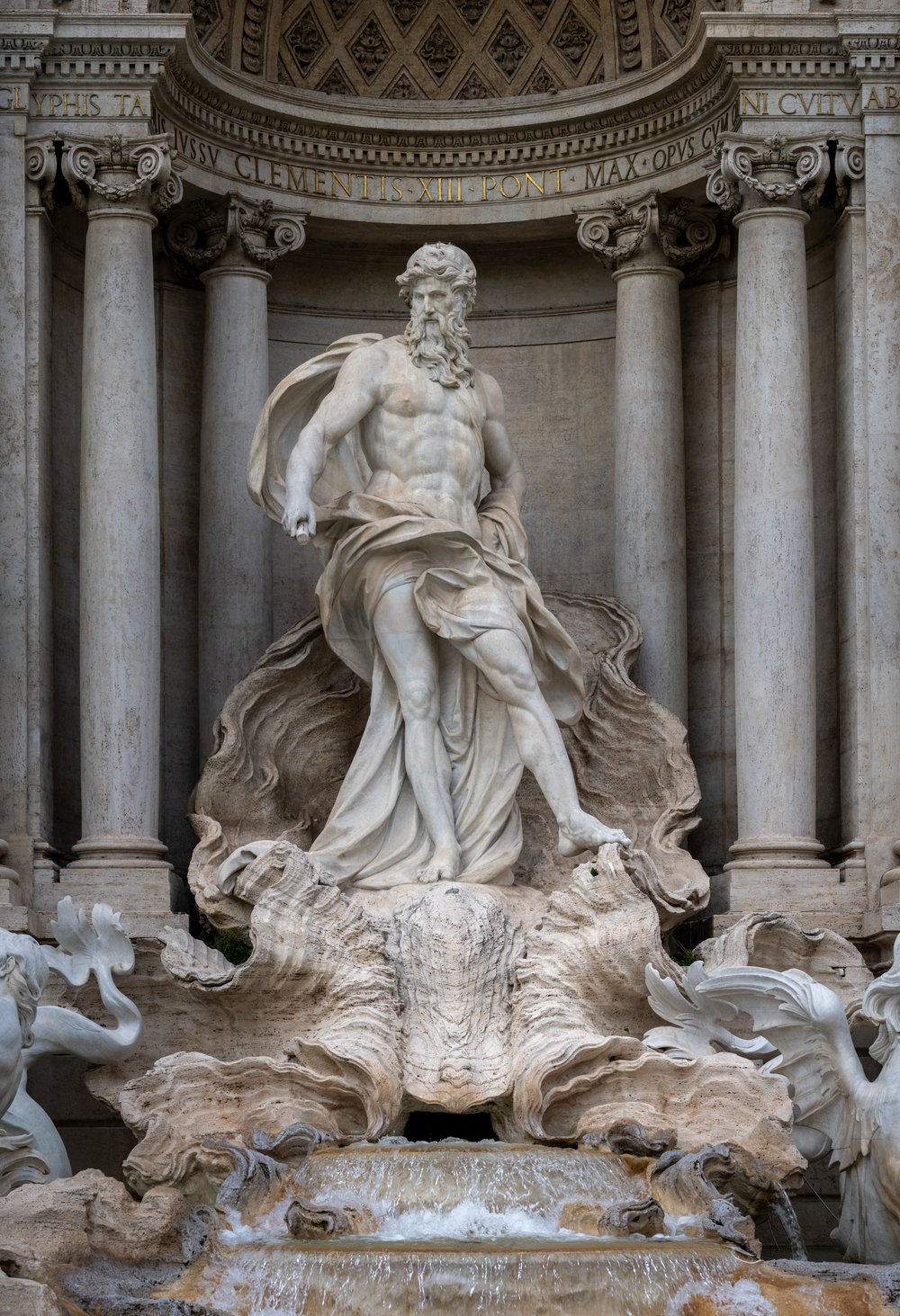 Oceanus in the central niche, sculpted by Pietro Bracci. Wilfredor, CC0, via Wikimedia Commons
The taming of the waters 1732-1762
The stated theme of the composition is the taming of the waters: a rocky reef tumbles forward, mixing water and rockwork, with the god Oceanus riding a shell chariot drawn by hippocamps guided by tritons. The tritons and horses are arranged for symmetrical balance with maximum contrast in mood and pose; one horse rears while the other goes calm One reading of this: the two moods of the sea. In the niches flanking Oceanus stand Abundance, spilling water from her urn, and Salubrity, holding a cup from which a snake drinks. Above them, bas reliefs illustrate the Roman origin of the aqueducts: one shows Agrippa approving the aqueduct plans, the other the virgin showing the spring to the soldiers. A triumphal arch is superimposed on the facade of Palazzo Poli, which Salvi gave a new front with a giant order of Corinthian pilasters One reading of this: the palace wall reads as the cliff from which the water breaks. Its name derives from the Latin trivium, the junction of three roads where it stands.
A film career 1916-1960
The fountain's later life is a record of fame. It appears in Ottorino Respighi's 1916 symphonic poem Fountains of Rome, in the third movement, "The Trevi Fountain at Noon", in Roman Holiday (1953), in Three Coins in the Fountain (1954), and most famously in Federico Fellini's La Dolce Vita (1960), where Anita Ekberg wades into the water with Marcello Mastroianni. In 1973 the Italian postal service dedicated a stamp to it, and a Lego set of the fountain was released on 1 March 2025. The 1954 film fixed the coin legend in popular culture: popular versions add that a second coin brings romance with an Italian and a third brings marriage (or divorce), though these are film-era folklore, treated as legend rather than fact.
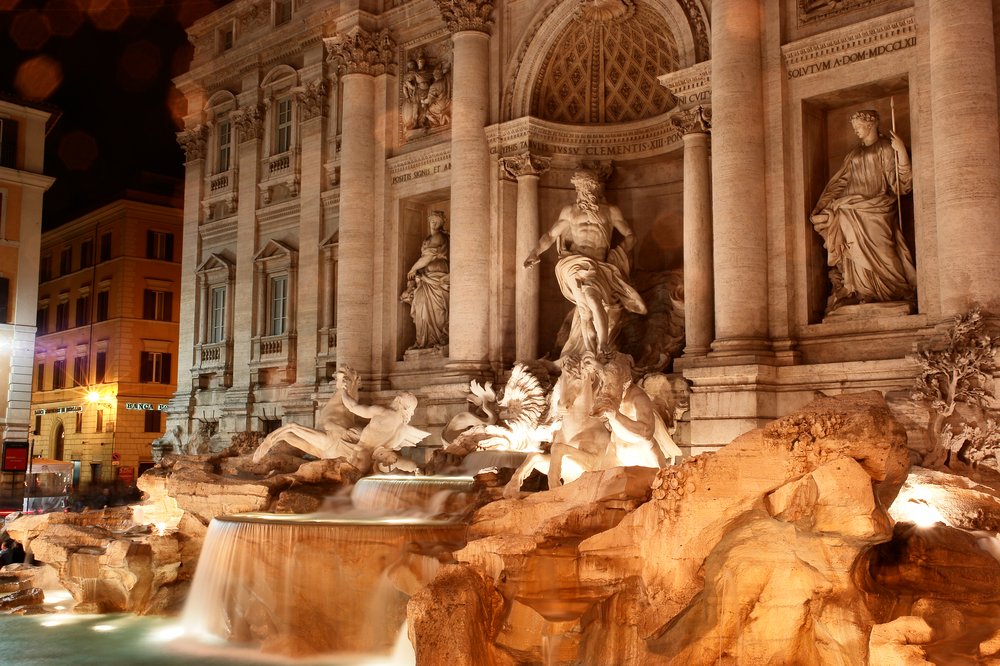 The fountain by night, lit by the LED system installed in the 2014 to 2015 restoration. RoyFokker, public domain, via Wikimedia Commons
Red dye and black charcoal 2007-2023
The fountain has also been a target. On 19 October 2007 the artist Graziano Cecchini poured red dye into the fountain as a protest against the cost of the Rome Film Festival, the red standing for the red carpet; he repeated the act on 26 October 2017. On 21 May 2023 the climate group Ultima Generazione dyed the water with charcoal. Stealing coins from the fountain is illegal, though attempts are regular.
Restored, queued, ticketed 1988-2026
The fountain was refurbished in 1988 to remove smog discoloration, and again in 1998, when the stonework was scrubbed, cracks repaired, and recirculating pumps installed. In January 2013 the fashion house Fendi announced it would sponsor a 20-month, 2.2-million-euro restoration, the most thorough in the fountain's history. Work began in June 2014 and finished in November 2015; the fountain reopened with an official ceremony on the evening of 3 November 2015, with more than 100 LED lights installed for the nighttime illumination. After a three-month restoration the fountain reopened in December 2024 with a queuing system around the lower basin and a maximum of 400 visitors at a time. On 2 February 2026 the City Council of Rome introduced a ticketing system: non-residents pay 2 euros to approach the fountain and throw coins, with access free after 10 p.m.
In the cultural conversation 1751-2003
The single most iconic fountain scene in cinema is Anita Ekberg wading into the Trevi in an evening gown in Fellini's La Dolce Vita (1960), calling Marcello Mastroianni's character to join her in the water. Three Coins in the Fountain (1954) made the coin-toss ritual a global practice, with Frank Sinatra's Oscar-winning title song fixing it in popular culture. The fountain also appears in Roman Holiday (1953) and, for a younger generation, in The Lizzie McGuire Movie (2003), where Lizzie tosses a coin, meets a pop star, and returns the next day.
Giovanni Battista Piranesi etched the fountain in 1751, in his Vedute di Roma series, while it was still being completed; impressions are held at the Metropolitan Museum of Art. No famous oil painting of the fountain in a major collection could be verified; the etchings are the notable visual-art record.
One fountain scene to strike from the list: the drowning sequence in Angels & Demons (2009) takes place at the Fontana dei Quattro Fiumi in Piazza Navona, not the Trevi.
Sources: Historical facts adapted from Wikipedia ("Trevi Fountain", CC BY-SA), Fountains of Papal Rome (1915), culturalheritageonline.com, the ANI report on Graziano Cecchini, and alchetron.com. Cultural appearances verified against Wikipedia, BFI, museum collection pages, and production coverage.
The Trevi Fountain in full, September 2022: Diego Delso, CC BY-SA 4.0, via Wikimedia Commons
Detail of Oceanus in the central niche: Wilfredor, CC0, via Wikimedia Commons
The Trevi Fountain at night: RoyFokker, public domain, via Wikimedia Commons