The story of the Sydney Opera House
The performing arts center on Bennelong Point, Sydney Harbour. Follow the building from the 1957 design competition to the 2022 Concert Hall renewal: fourteen shells, each a section of a single 75.2-meter sphere, and the architect who never saw it finished.
A competition, a champion 1955-1957
Planning began in the late 1940s, when the conductor Eugene Goossens lobbied the New South Wales premier Joseph Cahill for a dedicated opera venue; Goossens insisted on Bennelong Point. Cahill launched an international competition on 13 September 1955, with a grand prize of 5,000 pounds, for a 3,000-seat major hall and a 1,200-seat minor hall. It drew 233 entries from 32 countries. The jury included Eero Saarinen, who pulled Jorn Utzon's scheme from the final 30 and championed it. The assessors wrote that the diagrammatic drawings present a concept of an Opera House which is capable of becoming one of the great buildings of the world. The winner was announced on 29 January 1957: the Danish architect Jorn Utzon.
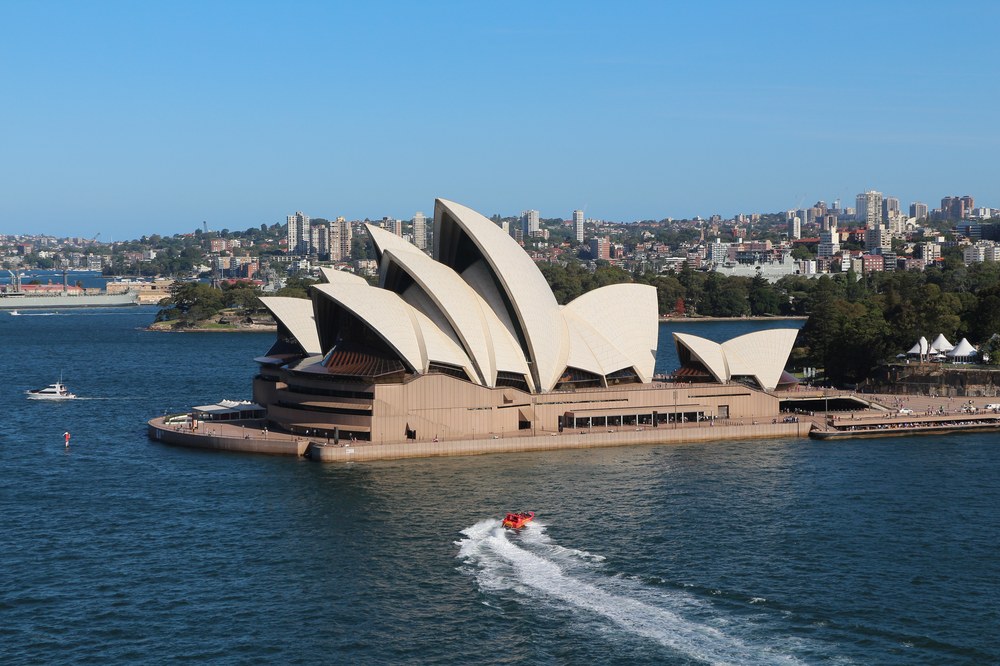
 The Opera House from the harbour in 2019, the shells reading white from a distance. Dietmar Rabich, CC BY-SA 4.0, via Wikimedia Commons
Tubowgule
The point is named for Bennelong, the Wangal and Eora man seized by Governor Arthur Phillip in 1789. To the Gadigal people of the Eora Nation it is Tubowgule, a gathering place for feasting, song, dance, and story for generations, flanked by Warrane (Sydney Cove) and Wahganmuggalee (Farm Cove). In 1788 it was briefly Cattle Point, then Limeburners' Point, where convict women burned its Aboriginal shell middens for lime. The Fort Macquarie Tram Depot was demolished in 1958 to clear the site. The site's Gadigal identity as a gathering place for story, song, and dance gives the building's purpose a deep continuity, made explicit by Badu Gili, water light in Gadigal, the First Nations light show projected on the sails each sunset since 2017.
One sphere 1961
Utzon's shells had undefined geometry, and from 1957 to 1963 the team ran at least 12 iterations: parabolas, circular ribs, ellipsoids. In mid-1961 came the breakthrough: every shell as a section of a single 75.2-meter sphere, so arches of varying length could be cast in common moulds and tiled in prefabricated sheets on the ground. Whose eureka it was is contested: Arup's letter credits Utzon, while Arup's biographer and design-team member Yuzo Mikami present the engineers' side. But all agree the architect-engineer collaboration was extraordinary, and the shell analysis was one of the earliest uses of computers in structural design. The roof is 2,194 precast concrete sections, up to 15 tonnes each, held together by 350 kilometers of tensioned steel cable; the roofs weigh 27,230 tonnes and the whole building 161,000 tonnes. Hornibrook engineer Joe Bertony developed an adjustable steel-trussed erection arch that supported the shells during construction.
Malice in Blunderland 1966
The Cahill government pushed construction to start on 2 March 1959 before designs were final; the podium columns were too weak for the roof and had to be rebuilt. After the 1965 election of Robert Askin's Liberal government, the Minister for Public Works Davis Hughes questioned every cost and schedule, withheld Utzon's fees, owed over 100,000 dollars by February 1966, and demanded procurement by tender rather than Utzon's chosen suppliers. On 28 February 1966 Utzon resigned, calling it Malice in Blunderland, and left Australia forever, after protests of up to 1,000 marched in Sydney demanding his reinstatement. Peter Hall, who had signed the petition for Utzon's reinstatement, took over the interiors and found nine years of work with no concise client brief and major unresolved questions of acoustics and capacity. The major hall became a concert-only hall with 2,679 seats; opera moved to the minor hall, now the Joan Sutherland Theatre, which remains too small for large-scale opera and ballet. Utzon's plywood interiors and acoustic designs were scrapped; his stage machinery was pulled out and largely thrown away, as documented in the 1968 BBC film Autopsy on a Dream.
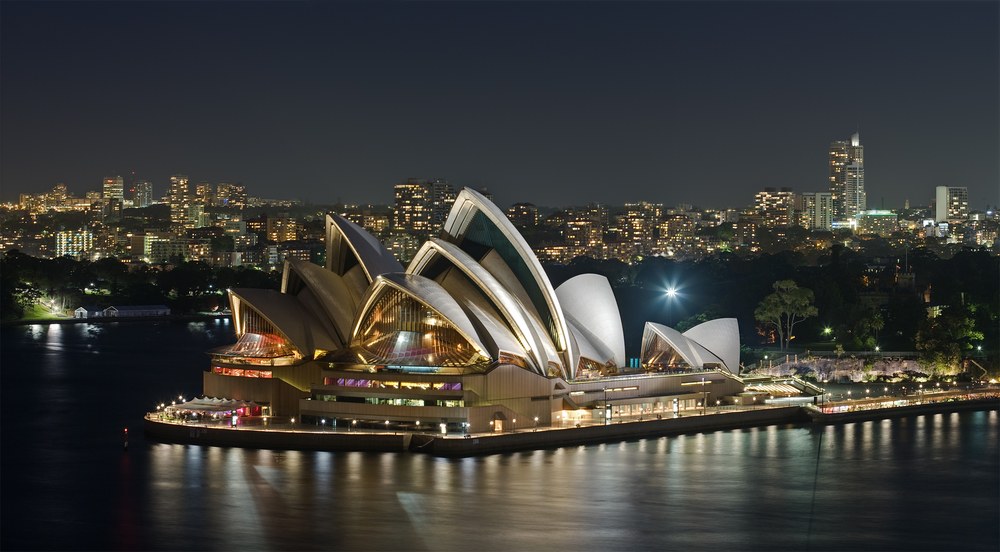 A wide view of the Opera House from the harbour, December 2008. Diliff, CC BY-SA 3.0, via Wikimedia Commons
The long way back 1973-2008
Formally completed in 1973 at 102 million Australian dollars, ten years late and 1,357 percent over budget in real terms, the building was opened by Queen Elizabeth II on 20 October 1973 with fireworks and Beethoven's Ninth. It is frequently claimed, erroneously, that Utzon was not invited and went unmentioned: he was invited but declined to avoid overshadowing the event, and Premier Askin credited him in his speech. Reconciliation came late: Utzon was appointed design consultant in 1999, won the Pritzker Prize in 2003, and the Utzon Room opened in 2004 with his 14 by 3.7-meter tapestry Homage to Carl Philipp Emanuel Bach. He died on 29 November 2008, never having returned to Australia or seen the finished building.
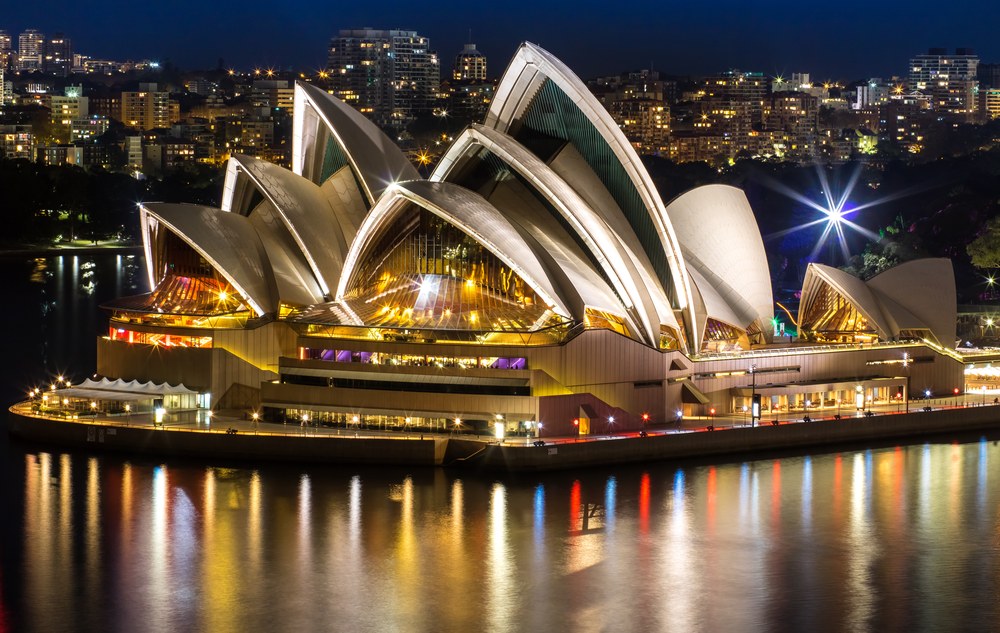 The Opera House illuminated at night, with the harbour city behind it. Thomas Adams, CC BY-SA 4.0, via Wikimedia Commons
A decade of renewal 2013-2023
The Decade of Renewal ran from 2013 to 2023 at about 300 million Australian dollars. Its largest project was the Concert Hall renewal by ARM Architecture and Arup: closed in February 2020, reopened on 20 July 2022 at 190 million dollars, with 18 magenta acoustic petals replacing the perspex doughnuts, the stage lowered 40 centimetres, new staging systems, and improved accessibility. The Sydney Symphony Orchestra reopened it with Mahler's Resurrection under Simone Young. Earlier, the Western Foyer was refurbished in 2009 by Utzon and his son Jan, the largest project since the 1999 re-engagement, and in 2016 the Le Corbusier tapestry Les Dés Sont Jetés, The Dice Are Cast, commissioned by Utzon in 1959 and kept by his family for more than 50 years, was finally hung in the Western Foyer.
The harbour's canvas
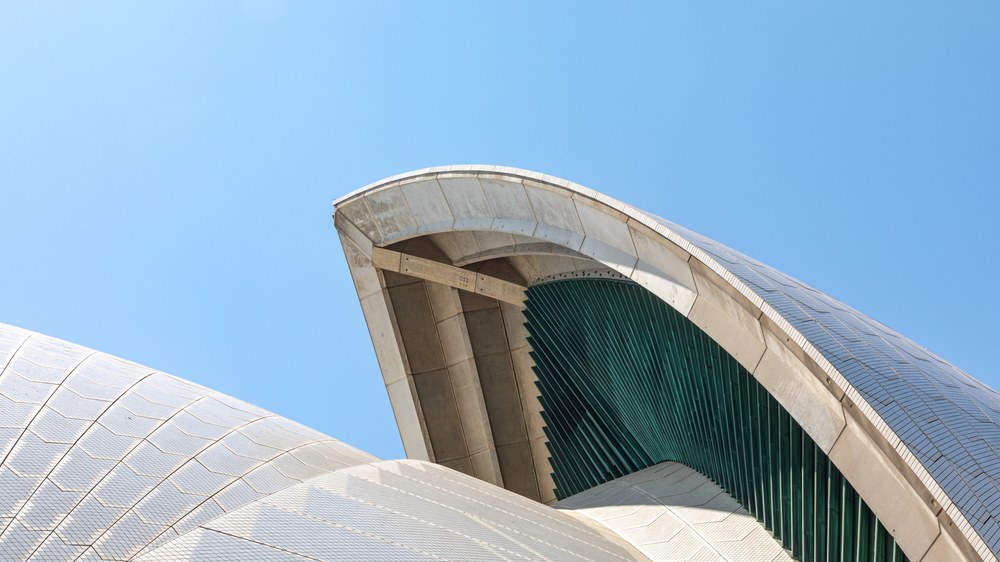
The building became a UNESCO World Heritage Site in 2007 under criterion i. The sails became a projection screen: the 2013 International Fleet Review lightshow, the 40th anniversary, and the nightly Vivid projections turned the shells into the harbour's canvas. That canvas is contested: in October 2018 CEO Louise Herron refused the sails as a billboard for the Everest horse race, Premier Gladys Berejiklian overruled her, and a 298,000-signature petition and 81 percent public opposition followed. Its history of firsts runs deeper: in 1960 Paul Robeson was the first artist to perform at the site, singing Ol' Man River to construction workers at lunch. The 1,056,006 tiles, glossy white and matte cream in a chevron pattern, read as uniform white from a distance and reveal their texture up close: an industrial material, made by the Swedish company Höganäs AB, elevated to a monument.
 The Opera House exterior, tile chevron visible on the shells. Bernard Gagnon, CC BY-SA 3.0, via Wikimedia Commons
In the cultural conversation 2000-2014
Pixar's Finding Nemo (2003) made the animated Opera House the signature landmark of its Sydney Harbour sequences: after Marlin and Dory are expelled from the whale, Nigel the pelican flies them over the building to the dentist's office where Nemo is held, introducing the sails to a generation of children worldwide. John Woo's Mission: Impossible 2 (2000) used the Opera House, Harbour Bridge and Sydney Tower as its Sydney geography, with the finale staged in the park directly behind the building. In Godzilla: Final Wars (2004) Godzilla hurls the monster Zilla into the Opera House and destroys them both with his atomic breath, a demolition the production pre-publicized before release.
The ABC sitcom Modern Family devoted its 2014 Australia episode to a Sydney sightseeing tour built around the Harbour Bridge and the Opera House; shot on location, it drew 9.59 million US viewers and was followed by a reported 25 percent lift in Qantas enquiries from Americans looking to visit Australia.
Brett Whiteley, Australia's most celebrated modern painter, took a decade to complete his painting Opera House, which he exchanged with Qantas for a period of free air travel; it sold at Sotheby's Sydney in 2007 for A$2.88 million, then the highest auction price achieved for the artist. Ken Done has made the building a signature recurring motif across his pop-art Sydney Harbour paintings for decades.
Sources: Historical facts adapted from Wikipedia ("Sydney Opera House", CC BY-SA), the Sydney Opera House Trust, Structurae, and Australian Geographic. Cultural appearances verified against Wikipedia, BFI, museum collection pages, and production coverage.
Sydney Opera House from the harbour, 2019: Dietmar Rabich, CC BY-SA 4.0, via Wikimedia Commons
Wide view of the Opera House, December 2008: Diliff, CC BY-SA 3.0, via Wikimedia Commons
The Opera House illuminated at night: Thomas Adams, CC BY-SA 4.0, via Wikimedia Commons
Sydney Opera House exterior: Bernard Gagnon, CC BY-SA 3.0, via Wikimedia Commons