The story of the Pyramid of the Sun
The largest building of Teotihuacan, the great Mesoamerican city northeast of Mexico City. Toggle between the pyramid as built around 200 AD and as restored in 1905 to 1910, when the fifth tier you can climb today was added.
A city built by strangers c. 200 AD
The Pyramid of the Sun is the largest building in Teotihuacan, the great Mesoamerican city about 40 kilometers northeast of modern Mexico City, and one of the largest pyramids in the New World. It stands about 65.5 meters high on a base of roughly 225 by 230 meters, with a volume near 1.18 million cubic meters: the third-largest ancient pyramid in the New World, after the Great Pyramid of Cholula and La Danta at El Mirador. Nobody knows who built it or what they called it. The Teotihuacanos left no readable record of their language, their rulers, or their place-names. The name Pyramid of the Sun comes from the Aztecs, who visited the city centuries after its abandonment; they called the city Teotihuacan, often understood as the place where the gods were made. At its peak around 450 AD the city held perhaps 100,000 to 200,000 people, among the largest cities on earth. Around 750 AD it was burned and abandoned, possibly in an internal uprising of the poor against the elite.
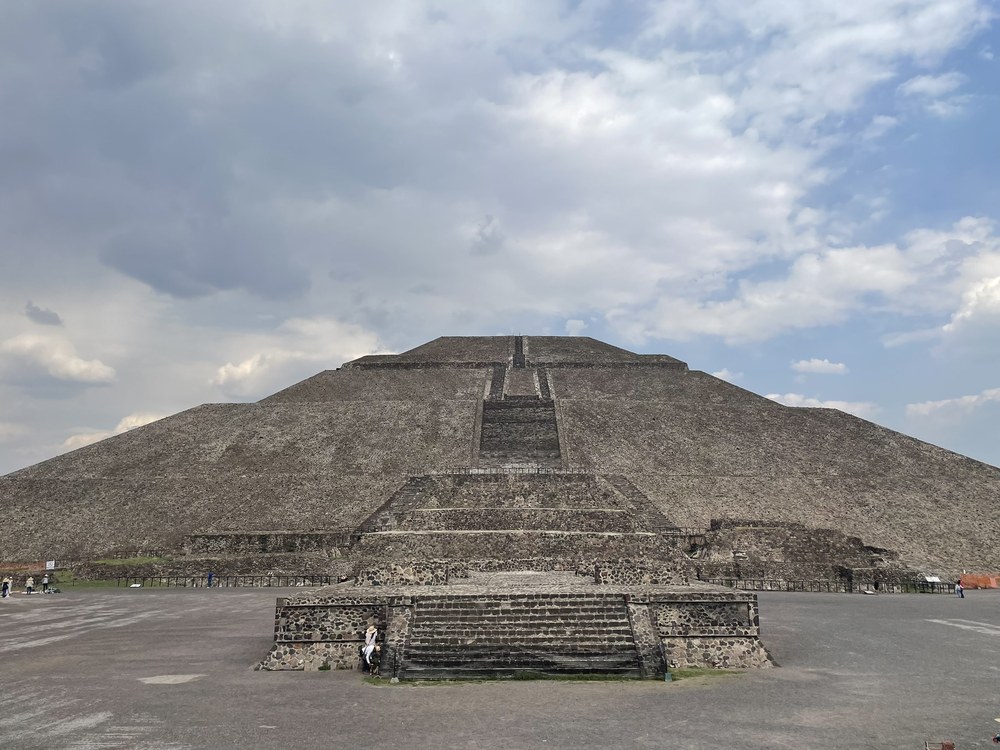 The Pyramid of the Sun from the west, with the grand staircase facing the Avenue of the Dead. Peachseltzer, CC BY-SA 4.0, via Wikimedia Commons
Two phases, one vanished crown c. 200 AD
Construction ran in two phases around 200 AD. The first brought the pyramid to nearly its present size; the second finished it at 225 meters across and 75 meters high and added an altar on the summit, which has not survived. The Teotihuacanos coated the pyramid in lime plaster imported from surrounding areas and painted it with brilliantly colored murals. The plaster and paint are gone, but jaguar heads and paws, stars, and snake rattles are among the few images associated with the building. The summit temple was destroyed by deliberate and natural forces before archaeology began, so no one can say which deity the pyramid venerated. Excavations found child burials at the pyramid's corners, believed to be sacrificial dedications made when the building was raised, and caches of obsidian arrowheads and human figurines inside that may have represented sacrificial victims. It was built by hand: workers carried baskets of crushed bedrock and soil, and the craftsmanship argues against slave labour.
The cave beneath the mountain 1959-1971
The pyramid's deepest secret is under it. A cave and tunnel system runs beneath the structure, investigated since 1959. In 1971 the archaeologist Ernesto Taboada found a seven-meter-deep pit at the foot of the main staircase leading to a grotto six meters below the pyramid's center, ending in a cloverleaf chamber that had been looted in antiquity. Long thought to be a natural lava tube, the space is now believed to be man-made and may have served as a royal tomb or shrine. The archaeologist Doris Heyden argued the cave was the reason for the pyramid's location: the grotto was a sacred focal point first, and the pyramid was built over it, not the other way around. In Mesoamerica, caves were the wombs of the Earth from which peoples emerged, and offerings were placed in them for deities such as the earth god Tepeyollotl, the fire god Xiuhtecuhtli, and the rain god Tlaloc. Some identify this grotto with Chicomoztoc, the mythical place of human origin in Nahua legend. One reading of this: if Heyden is right, the pyramid monumentalizes an origin place, the earth's surface erupted into architecture above the underworld's mouth.
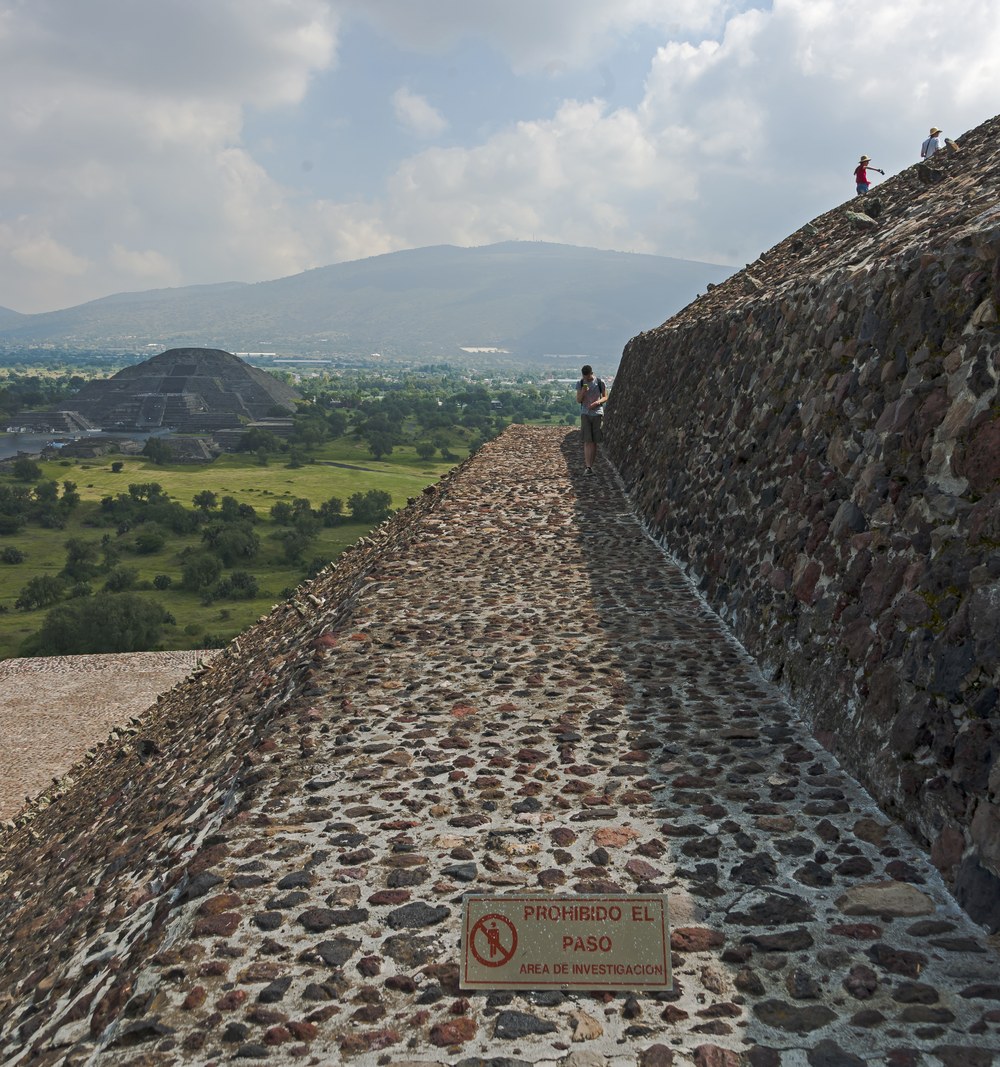 Along a terrace of the pyramid; the visible five tiers include a 20th-century addition. Daniel Case, CC BY-SA 3.0, via Wikimedia Commons
A calendar in stone
The pyramid was built on a carefully selected spot, aligned both to Cerro Gordo on the northern horizon and, perpendicular to that, to sunrises and sunsets on specific dates, including sunsets on 12 August and 29 April. The entire central urban grid of Teotihuacan, including the Avenue of the Dead, reproduces the Sun Pyramid's orientation, offset 15.5 degrees east of true north, and the peak was positioned to serve as a natural horizon marker of the sun's position on the quarter days of the year. One reading of this: the pyramid was a monumental calendar and observatory, syncing the city's ritual life to the solar cycle. The Avenue of the Dead runs north to south for more than 3 kilometers at 45 meters wide, with the pyramid on its east side between the Pyramid of the Moon to the north and the Ciudadela to the south. A few centuries after completion, a four-level adosada platform was built over the original west facade, decorated with sculpted feline heads and circular chalchihuite fertility motifs, all stuccoed and painted in multiple colors.
The fifth tier is a restoration 1905-1910
What visitors climb today partly reflects a 20th-century showpiece. In 1905 the archaeologist Leopoldo Batres, under Porfirio Diaz's regime, launched a major excavation and restoration, rushing the Pyramid of the Sun into presentable shape for the 1910 centennial of Mexican independence. The site had been expropriated for the national patrimony under the 1897 Law of Monuments, some 250 farming plots were cleared, and a feeder railway was built in 1908 to haul material and later tourists. In 1910 the International Congress of Americanists, with figures such as Eduard Seler and Franz Boas, was taken to the newly finished excavations. Critics note the work was hasty: Batres arbitrarily added a fifth terrace level and removed many original facing stones. The original pyramid had four tiers, so any numerological reading of five levels reads the restoration, not the Teotihuacano design.
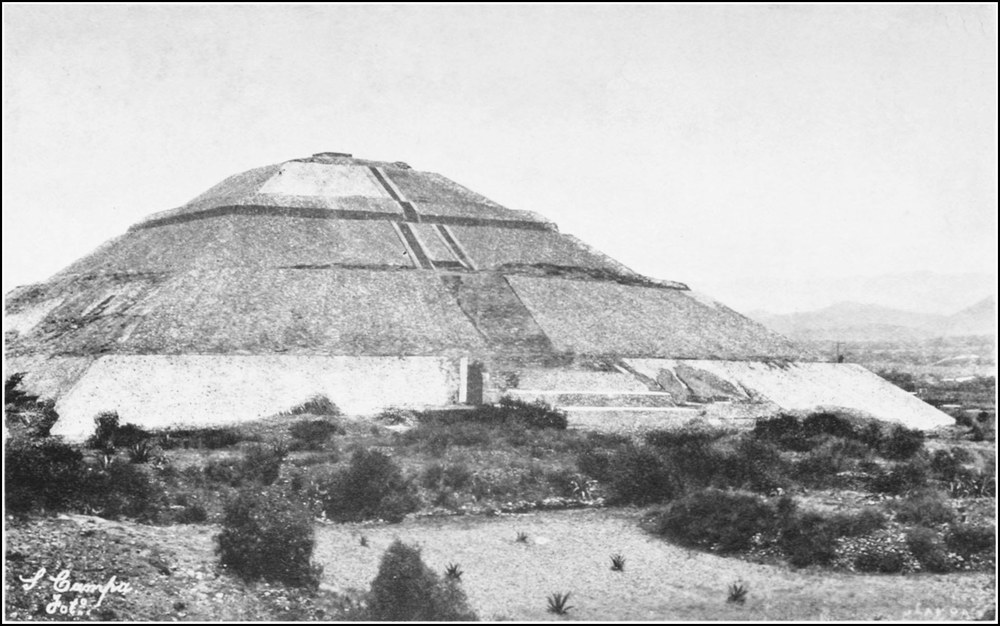 A vintage view of the pyramid, before and during the era of its 20th-century restoration. Unknown author, public domain, via Wikimedia Commons
The ruin today 1959-today
Later science has been kinder. René Millon's team investigated the sub-pyramid tunnels in 1959, the INAH site-wide project of 1960 to 1965 under Jorge Acosta cleared the Avenue of the Dead and consolidated its facades, and in 2013 modern muon detectors scanned the interior for hidden chambers. Teotihuacan was inscribed as a UNESCO World Heritage Site in 1987. A unique early find, the Teotihuacan Ocelot recovered near the pyramid's foot in the 19th century, now sits in the British Museum. Each March thousands gather at the pyramid, many dressed in white, climbing to raise their arms to the sun in a recharging energy ceremony. It is a modern tradition with no verified ancient equinox ritual at the pyramid; its meaning is contemporary: community, renewal, and a felt connection to deep time.
In the cultural conversation 2006-2016
The Pyramid of the Sun has no fiction-film career; its screen life is documentary. The History Channel's Digging for the Truth: City of the Gods (2006) devoted an hour to Teotihuacan, presented as home of the third-largest pyramid in the world, exploring the great city above and the shafts below in search of the civilization's origins. PBS's Secrets of the Dead: Teotihuacan's Lost Kings (2016) followed the team investigating newly found chambers and a sealed tunnel beneath the city's pyramids. No famous painting of the structure in a known collection could be verified.
The one fiction film with a matching title does not count: the 1965 German adventure The Pyramid of the Sun God used a studio-built pyramid at Spandau Studios in Berlin, not Teotihuacan.
Sources: Historical facts adapted from Wikipedia ("Pyramid of the Sun" and "Teotihuacan", CC BY-SA) and Encyclopaedia Britannica ("Teotihuacan"). Cultural appearances verified against Wikipedia, BFI, museum collection pages, and production coverage.
Frontal view of the Pyramid of the Sun: Peachseltzer, CC BY-SA 4.0, via Wikimedia Commons
Vintage view of the Pyramid of the Sun: unknown author, public domain, via Wikimedia Commons
View along a terrace of the pyramid: Daniel Case, CC BY-SA 3.0, via Wikimedia Commons