The story of the Palace of Westminster
The meeting place of the UK Parliament has been a royal palace, a burned ruin, a construction site, and a target for 800 years. Explode its towers, chambers, and lobbies to see how a building became the emblem of British democracy.
The king's palace becomes Parliament's home 1045-1834
The site may have been used by Cnut, and from around 1045 to 1050 Edward the Confessor built a palace and the first Westminster Abbey. The oldest surviving part of the palace is Westminster Hall, dating from the reign of William II: erected in 1097, it was then the largest hall in Europe. The palace was the principal residence of the English monarchs in the late medieval period, and Parliament, the predecessor Curia Regis, met in Westminster Hall when the king was in residence. The Model Parliament, considered the first Parliament of England, met at the palace in 1295. In 1512 a fire destroyed the royal apartments, and in 1534 Henry VIII moved to the Palace of Whitehall, seized from Cardinal Thomas Wolsey; from that point Westminster's main occupants were the two houses of Parliament and various courts of law. The Commons adapted St Stephen's Chapel for its use in the 16th century; the Lords used the Painted Chamber and, from 1801, the White Chamber. On 5 November 1605 conspirators including Guy Fawkes placed gunpowder beneath the House of Lords to detonate during the State Opening. The plot was discovered; the survivors were tortured in the Tower of London, tried for high treason in Westminster Hall, and executed by hanging, drawing and quartering. Since then the cellars have been searched by the Yeomen of the Guard before every State Opening. On 4 January 1642 Charles I entered the Commons Chamber to arrest five members; Speaker William Lenthall replied, "May it please your Majesty, I have neither eyes to see nor tongue to speak in this place but as the House is pleased to direct me, whose servant I am here." The sovereign has not entered the Commons since; at each State Opening Black Rod has the chamber doors slammed in his face and must strike three times with the staff to be admitted. On 11 May 1812 Prime Minister Spencer Perceval was shot dead by John Bellingham in the Commons lobby; he remains the only British prime minister assassinated.
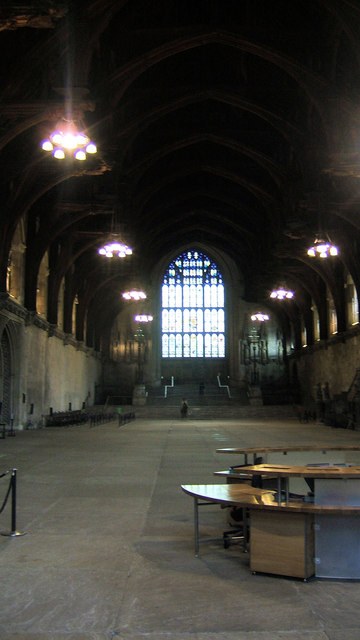 Westminster Hall, the oldest surviving part of the palace, erected in 1097 and then the largest hall in Europe. Kevin Gordon, CC BY-SA 2.0, via Wikimedia Commons
The fire Turner painted 16 Oct 1834
On 16 October 1834 a fire broke out after an overheated stove used to destroy the Exchequer's stockpile of tally sticks set fire to the House of Lords chamber. Both Houses were destroyed with most of the palace complex. Westminster Hall was saved thanks to firefighting efforts and a change in wind direction; the Jewel Tower and the undercroft, cloisters and chapter house of St Stephen's Chapel also survived. J. M. W. Turner watched the fire and painted several canvases of it, including The Burning of the Houses of Lords and Commons (1835).
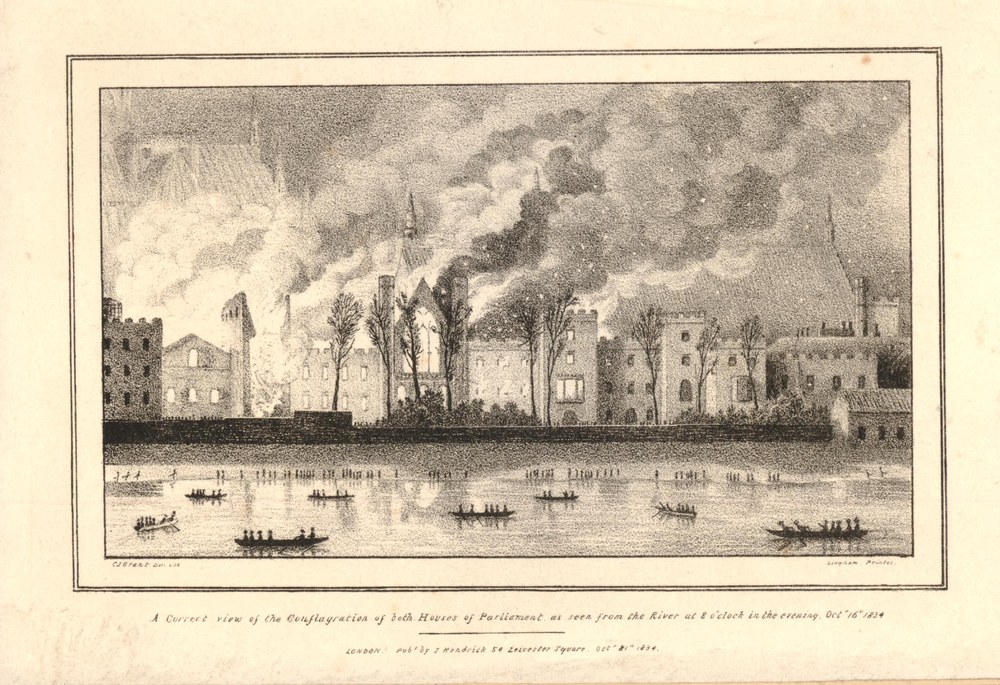 A contemporary print of the fire of 16 October 1834, seen from the river at 8 o'clock in the evening. Charles Jameson Grant (printmaker), public domain, via Wikimedia Commons
Barry, Pugin, and the Gothic Revival palace 1840-1876
The design competition for the new palace was won by Charles Barry, who chose a Gothic Revival style and relied heavily on Augustus Pugin for the details. Construction started in 1840 and ran for 30 years, with delays, cost overruns, and the deaths of both Barry and Pugin. The Lords Chamber was completed in 1847, the Commons Chamber in 1852; work was not finished until a decade after most of it had been carried out by 1860. The result is Perpendicular Gothic Revival, Grade I listed since 1970 and part of a UNESCO World Heritage Site since 1987, with Westminster Abbey and St Margaret's Church. Barry had adopted the portcullis as his identifying mark in the design competition, which was judged pseudonymously, and he and Pugin then saturated the new palace with the emblem: carved in stone and wood, stamped on leatherwork, on Commons Library books, on curtains and wallpaper, and cast in the metal of Big Ben. That saturation led to its adoption as the quasi-official symbol of the House of Commons and of Parliament. Portcullis House, the parliamentary office building completed in 2000, is named for it.
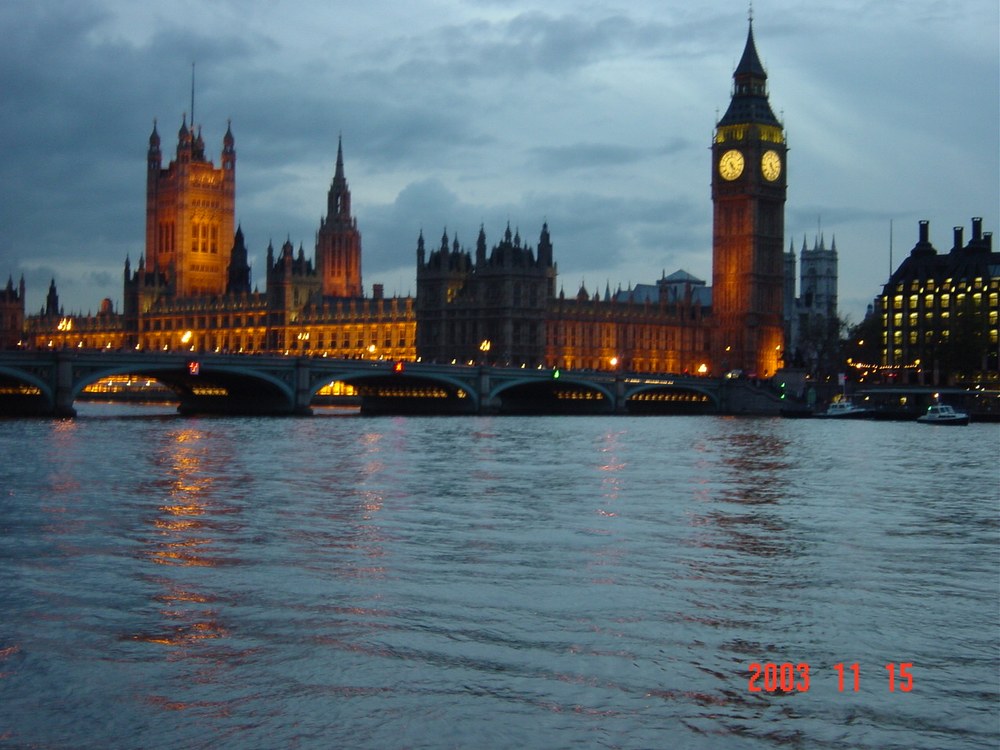 The palace from across the Thames at evening, with Westminster Bridge. Photomaniac, public domain, via Wikimedia Commons
A building coded with nationhood
The building is a coded statement about British nationhood. The Robing Room's decorative theme is the legend of King Arthur, considered by many Victorians the source of their nationhood: five frescoes by William Dyce (1848 to 1864) depict allegorical scenes from the legend, each representing a chivalric virtue, the largest the Admission of Sir Tristram to the Round Table, illustrating Hospitality. The Royal Gallery displays British military history: two large Daniel Maclise paintings, The Death of Nelson at Trafalgar (1805) and The Meeting of Wellington and Blücher after Waterloo (1815), and eight gilded Caen stone statues flanking the doorways, each a monarch from whose reign a major battle or war dates: Alfred the Great and William the Conqueror; Richard I and Edward III; Henry V and Elizabeth I; William III and Anne. The Prince's Chamber takes Tudor history: 28 oil portraits of the dynasty by Richard Burchett and his pupils, and 12 bronze bas-reliefs by William Theed including the Field of the Cloth of Gold; a statue of Queen Victoria seated on a throne is flanked by allegorical figures of Justice, with bare sword and inflexible expression, and Clemency, offering an olive branch, positioned so the monarch would see it walking to the throne. The Central Lobby's tympana carry mosaics of the patron saints of the United Kingdom's nations: Saint George for England, Saint Andrew for Scotland, Saint David for Wales, Saint Patrick for Ireland; the Minton encaustic tile floor includes a Latin passage from Psalm 127: "Except the Lord build the House their labour is but lost that build it". In the Peers' Lobby the floor centrepiece is a radiant Tudor rose in Derbyshire marbles, and above the arches are the arms of the six royal dynasties that ruled England up to Victoria's reign. In the Lords Chamber the Woolsack, an armless red cushion stuffed with wool, represents the historical importance of the wool trade; the presiding officer sits on it, and the House's mace, representing royal authority, rests on its back. In the Commons Chamber the two red lines on the floor are 2.5 metres apart; by apocryphal tradition this is just over two sword-lengths, though there is no record of MPs ever being allowed swords in the chamber. The Ayrton Light was installed in the lantern of the Elizabeth Tower in 1885 at Queen Victoria's request so she could see from Buckingham Palace whether the members were "at work"; it is lit when either House sits after dark. And in Westminster Hall the 83 depictions of Richard II's favourite heraldic badge, the resting chained White Hart, built into the 1393 remodelling, are a statement of the king's personal authority.
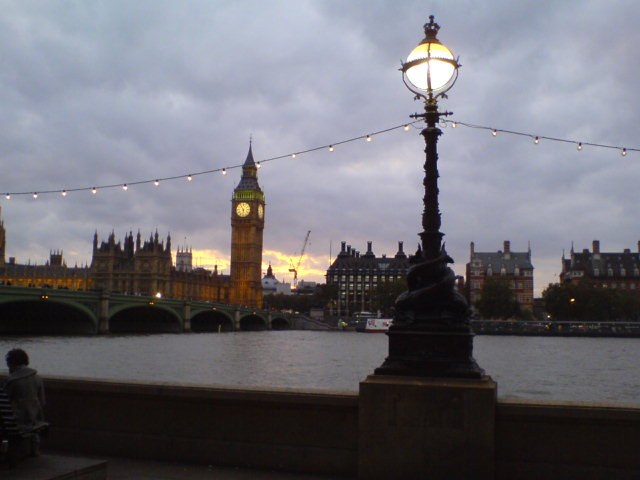 The Elizabeth Tower and the river front along the Thames. Schlosser67, CC BY-SA 2.0, via Wikimedia Commons
The Blitz and the simplified Commons 1885-1950
On 24 January 1885 Fenian bombs exploded at the palace and the Tower of London; a black bag of dynamite discovered on the steps to St Mary Undercroft injured two constables and damaged the chapel. In February 1907, after the King's Speech ignored women's rights, about 400 suffragettes under Emmeline Pankhurst and Charlotte Despard stormed Parliament; 60 were arrested. On 28 October 1908 came the Grille Incident: members of the Women's Freedom League chained themselves to the grille of the Ladies' Gallery during a debate, and the whole grille had to be unscrewed. In April 1909 four women chained themselves to statues in St Stephen's Hall. During the Second World War the palace was hit by bombs on fourteen separate occasions. On 26 September 1940 a bomb lifted the statue of Richard the Lionheart from its pedestal and bent its sword; the image was used as a symbol of the strength of democracy, "which would bend but not break under attack". In the night of 10 to 11 May 1941 the palace took at least twelve hits and three people were killed, two policemen and Edward Elliott, Resident Superintendent of the House of Lords. The Commons Chamber and the roof of Westminster Hall were both set alight; the firefighters could not save both, so the hall was prioritised and saved while the chamber was destroyed. The Lords Chamber and the Clock Tower were damaged in the same raid. The Commons Chamber was rebuilt in a simplified style under Giles Gilbert Scott and completed in 1950; it was opened by George VI on 26 October 1950. The Members' Lobby archway leading into it was deliberately left unrepaired as a reminder of the war, now known as the Rubble Arch or Churchill Arch, flanked by bronze statues of Winston Churchill and David Lloyd George whose feet are rubbed shiny by MPs for luck before maiden speeches.
A palace awaiting rescue as of October 2026
Barry's palace was rebuilt in sand-coloured Anston magnesian limestone from South Yorkshire, chosen after an 1839 quarry tour. The stone soon began to decay from pollution and poor quality; nothing was done through the 19th century even though defects were clear by 1849. In 1928 it was decided to replace decayed Anston stone with honey-coloured Clipsham limestone from Rutland; the project began in the 1930s, was halted by the war, and finished in the 1950s. By the 1960s pollution was damaging the stonework again, and a conservation and restoration programme for the external elevations and towers ran from 1981 to 1994. The Royal Gallery's two Daniel Maclise frescoes deteriorated rapidly after completion from atmospheric pollution and are today almost monochrome; the remaining planned frescoes were cancelled. In January 2018 the House of Commons voted for both houses to vacate the palace to allow a complete refurbishment, expected to take at least six years and start no sooner than 2025. A Restoration and Renewal Client Board was formed in September 2022. As of February 2026 no plan had been agreed.
In the cultural conversation 1978-2005
In V for Vendetta (2005) the Houses of Parliament are the symbolic target of V's whole campaign, and the finale shows an explosive-laden Tube train destroying the building while a masked crowd watches, a sequence filmed on location at Parliament Square. The image made Parliament a permanent shorthand for the idea of a people overthrowing a state.
Big Ben keeps getting hit. In Doctor Who: Aliens of London (2005) a crashing alien craft smashes through the clock tower and plunges into the Thames, one of the most re-watched images of the 2005 revival. Don Sharp's The Thirty Nine Steps (1978) ends with a climactic chase on the clock face, and Shanghai Knights (2003) stages its sword fight inside the tower, with the combatants bursting through the clock face. Tim Burton's Martians knock Big Ben down in Mars Attacks! (1996).
Claude Monet painted the building 19 times between 1900 and 1905, studying it through London fog from across the Thames; the series was the centerpiece of the Courtauld Gallery's 2024-25 Monet and London exhibition, with canvases in Washington and Paris. James McNeill Whistler's Nocturne: Grey and Gold, Westminster Bridge (1871-72), a night view with the towers at the right, is in the Burrell Collection in Glasgow.
Sources: Historical facts adapted from Wikipedia ("Palace of Westminster", CC BY-SA), UK Parliament Factsheet G9, and Historic England. Cultural appearances verified against Wikipedia, BFI, museum collection pages, and production coverage.
Westminster Hall, the oldest surviving part of the palace: Kevin Gordon, CC BY-SA 2.0, via Wikimedia Commons
Contemporary print of the 16 October 1834 fire: Charles Jameson Grant, public domain, via Wikimedia Commons
Evening view of the palace and Westminster Bridge: Photomaniac, public domain, via Wikimedia Commons
The Elizabeth Tower and the palace along the Thames: Schlosser67, CC BY-SA 2.0, via Wikimedia Commons