The story of One World Trade Center
The tallest building in the United States rose on the northwest corner of the 16-acre site, where 6 World Trade Center once stood. Explode its chamfered glass walls, concrete core, and spire to see how security, symbolism, and compromise shaped a skyscraper.
The towers that fell 1966-2001
The original World Trade Center was conceived as an urban renewal project spearheaded by banker David Rockefeller to revitalize Lower Manhattan, planned by the Port Authority of New York and New Jersey and designed by Minoru Yamasaki. Construction of the North Tower began in August 1966; the first tenants moved in October 1971, when it became the tallest building in the world at 1,368 ft. At 8:46 a.m. EDT on September 11, 2001, American Airlines Flight 11 struck the North Tower's northern facade; after burning for 102 minutes it collapsed at 10:28 a.m., and debris took down 7 World Trade Center later that day.
From competition to cornerstone 2001-2009
Proposals for reconstruction came almost immediately. The Lower Manhattan Development Corporation ran a design competition in 2002; after the public rejected the first round, a second competition in December 2002 selected Daniel Libeskind's "Memory Foundations" master plan in February 2003. The tower design was fought over: SOM replaced Libeskind as the tower's primary designer, and David Childs's symmetrical tapering tower beat out Libeskind's asymmetrical concept with its off-center spire after months of dispute with leaseholder Larry Silverstein, who limited office floors over fears of another attack. On December 19, 2003, Childs and Libeskind announced the joint "Freedom Tower" design: 1,776 ft tall. The symbolic cornerstone was laid on July 4, 2004, then removed in June 2006 during the money, security, and design disputes. On December 18, 2006, the public was invited to sign the first 30-ft steel beam before it was welded onto the base. In March 2009 the Port Authority dropped the "Freedom Tower" name, which had been mocked on programs like Saturday Night Live, in favor of the legal name One World Trade Center, partly because a traditional street address was easier to lease. First commercial tenant Vantone signed a 21-year lease; Condé Nast became anchor tenant in May 2011 with one million square feet.
A tower armored against attack 2005-2013
NYPD concerns about the all-glass base and the site's proximity to the West Side Highway forced a redesign in April 2005: a 187-ft windowless concrete base was added. The planned prismatic-glass cladding for the base was scrapped in 2011 after tests showed the prisms shattered into large, dangerous shards; it was replaced by stainless-steel panels with angled blast-resistant glass fins, LED-lit at night. Developer Douglas Durst's 2011 partnership brought a plaza redesign, including removal of a planned skylight that would have lit the below-ground observation lobby. Construction of the new tower began on April 27, 2006. The steel topped out in August 2012 at a roof height of 1,368 ft. In June 2012 President Barack Obama visited and wrote on a beam to be hoisted to the top: "We remember, we rebuild, we come back stronger!" Spire sections shipped from Quebec were installed from December 2012; the final piece went up May 10, 2013, bringing the full height to 1,776 ft. On November 12, 2013, the Council on Tall Buildings and Urban Habitat controversially ruled the mast a spire rather than an antenna, making 1 WTC the tallest building in the United States and the Western Hemisphere.
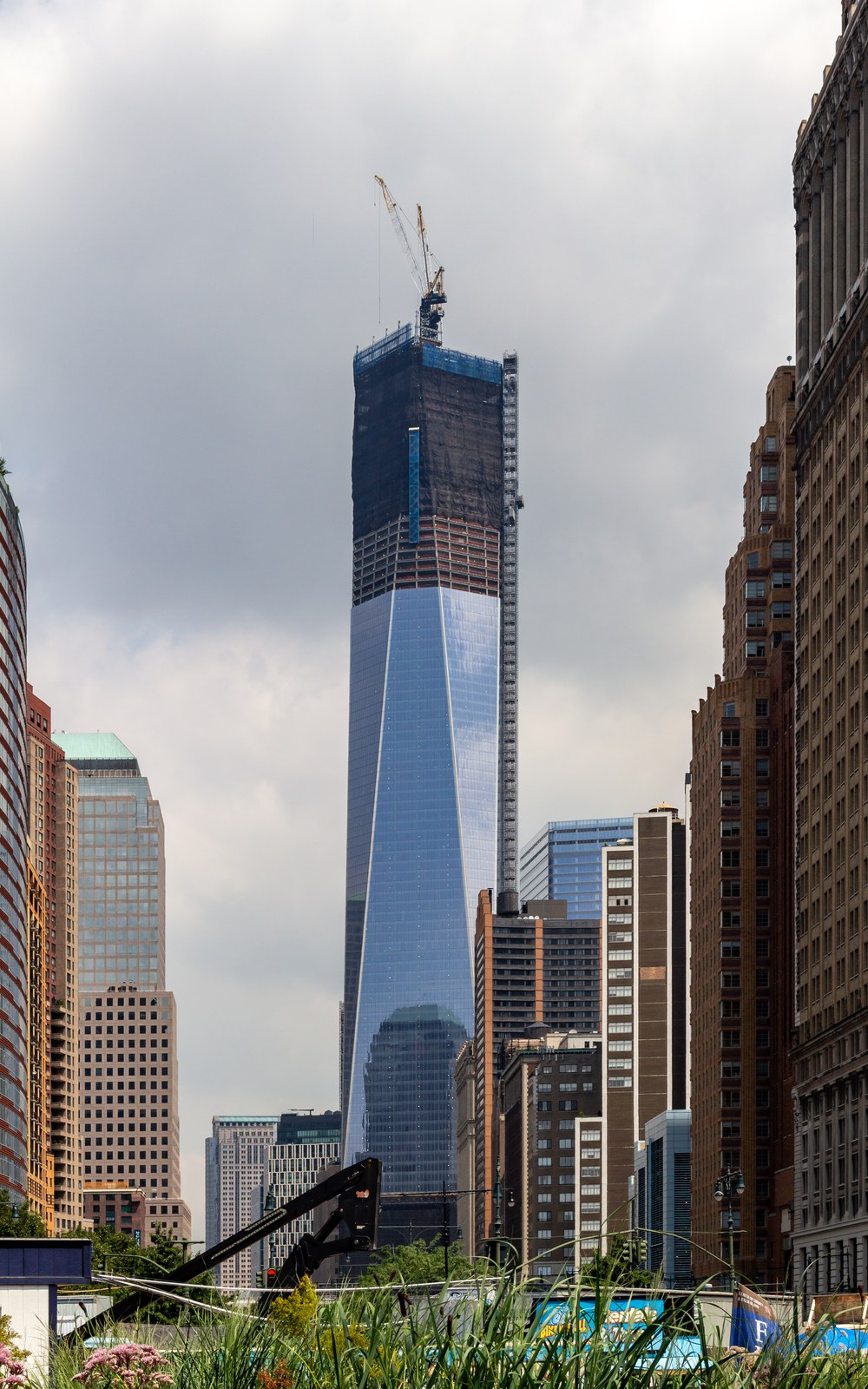 The tower under construction in 2012, climbing toward its symbolic 1,776 feet. Dietmar Rabich, CC BY-SA 4.0, via Wikimedia Commons
The symbolism in the measurements
The tower's measurements are deliberate memorials. The 1,776 ft height is the year the Declaration of Independence was signed, chosen by Libeskind for the master plan and retained by Childs. The roof at 1,368 ft is identical to the roof height of the original North Tower, a deliberate echo. The 200-ft square base is nearly the same footprint as the original Twin Towers. From the 20th floor up the chamfered edges create eight tall isosceles triangles; near the middle the tower is a perfect octagon; the parapet is a square rotated 45 degrees from the base. No verified symbolism is attached to the eight triangles or the octagon; they are documented as formal and geometric decisions. The spire works as a beacon: Libeskind described the night light at the top as "a beacon of light and hope in a world that is often dark," and the beacon at the spire's tip flashes Morse code for the letter N, for New York, "as lightships once did in great harbours of the world." Inside, the 65-ft lobby holds the 90-ft mural ONE: Union of the Senses by José Parlá; two paintings by Donald Martiny titled Lenape and Unami carry the names of the Lenape peoples of the region.
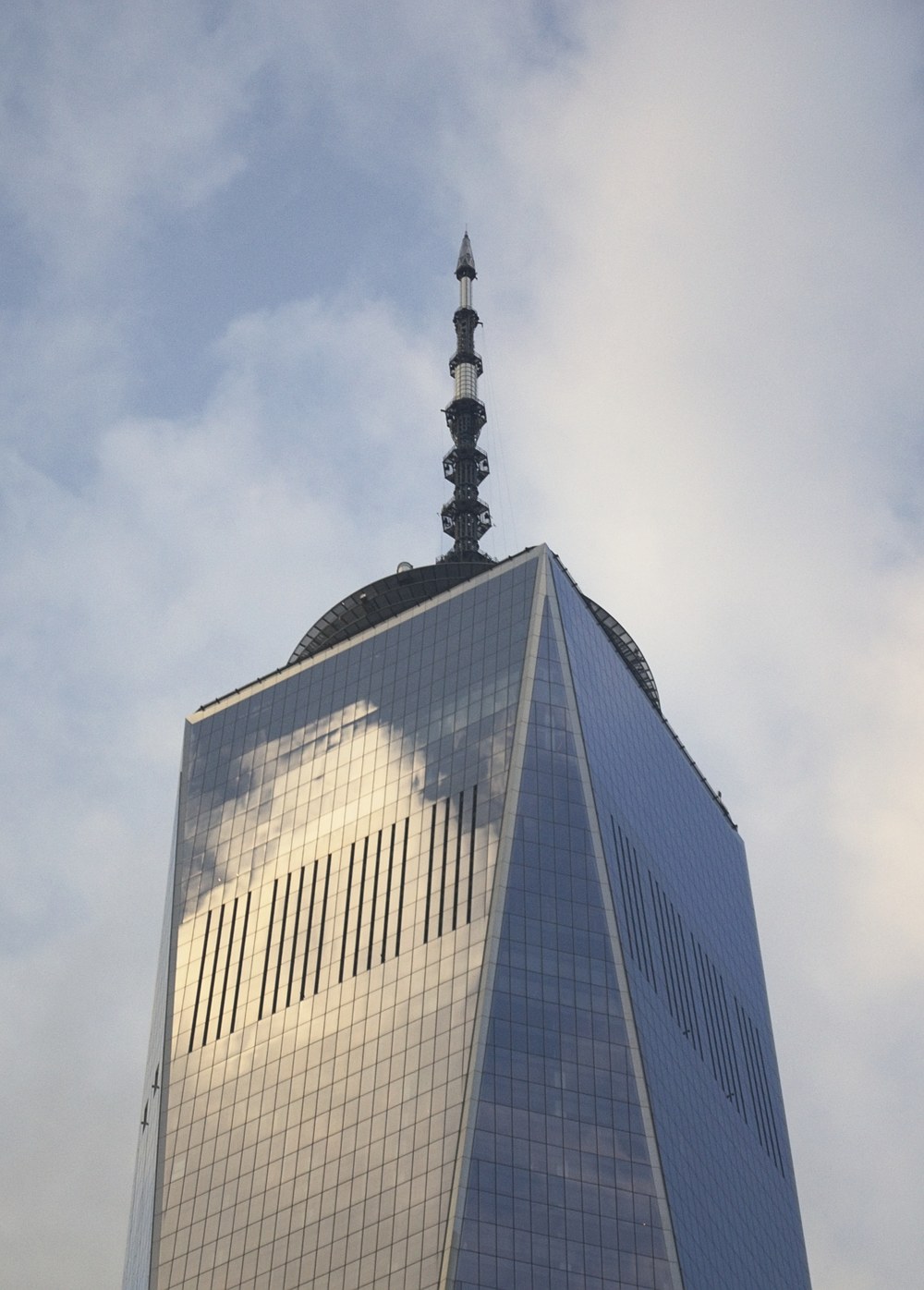 The spire, co-designed with artist Kenneth Snelson; its night beacon flashes Morse code for the letter N, for New York. Opencooper, CC0, via Wikimedia Commons
The most expensive building on earth 2014-today
The building opened on November 3, 2014, at a cost of US$3.9 billion, making it the most expensive building in the world at the time. It has 94 physical stories, the top floor numbered 104, plus five below ground. It stands at 285 Fulton Street on the northwest corner of the 16-acre site, on the footprint of the original 6 World Trade Center. The One World Observatory opened on May 29, 2015, on floors 100 to 102. It reached 92% occupancy just before COVID, survived Condé Nast's 2021 rent standoff, and was 95% leased by March 2022.
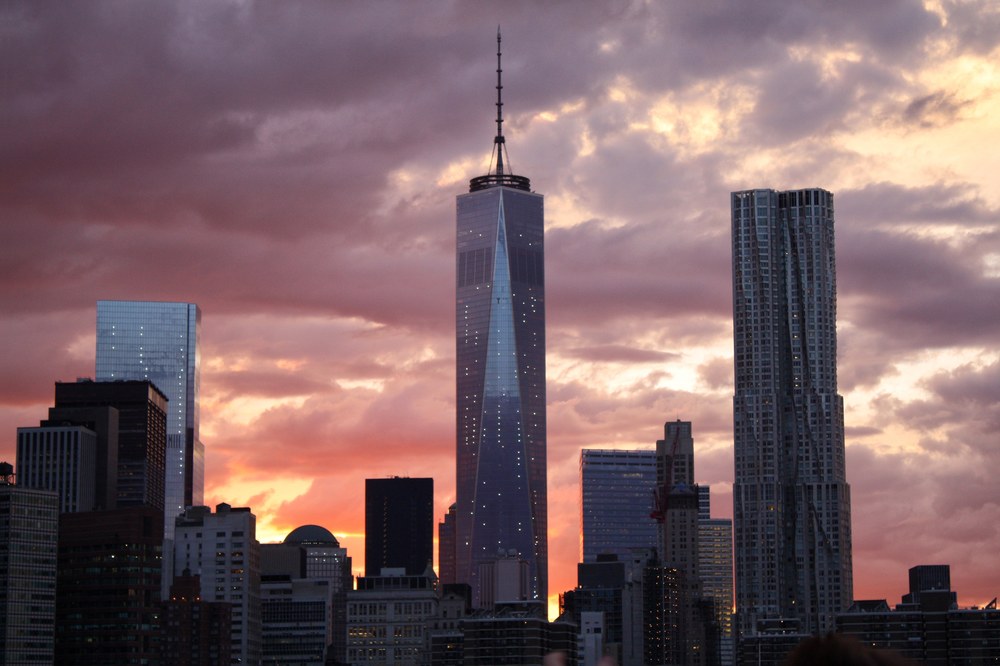 One World Trade Center at sunset, the tallest building in the Western Hemisphere. ID 2649771, CC0, via Wikimedia Commons
The site around it
The tower did not rise without incident. In March 2014, 16-year-old Justin Casquejo sneaked past security, through a hole in the fence, a passed-on elevator ride, and a sleeping guard, and climbed to the antenna: a major security scandal during construction. The site around the tower has settled into the rebuilt complex the design competition promised, with the memorial pools just south of the tower and the observatory drawing visitors to the top floors.
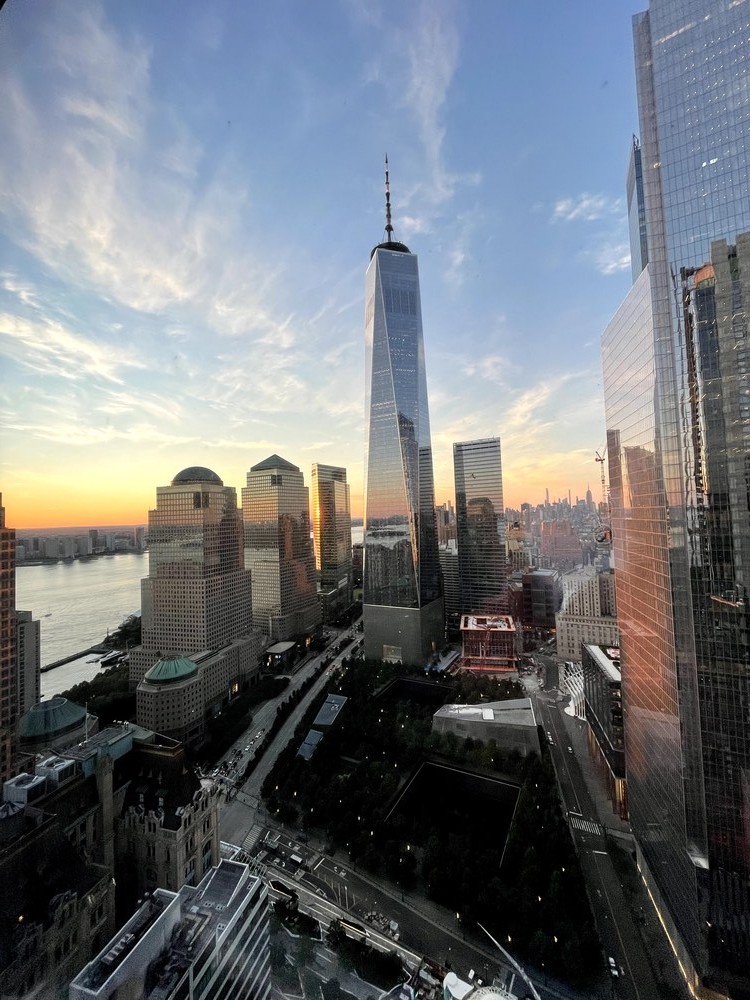 The rebuilt World Trade Center complex around the tower. Praneeth Thalla, CC BY-SA 4.0, via Wikimedia Commons
In the cultural conversation 2013
The new tower's most prominent screen appearance is Joseph Kosinski's Oblivion (2013), which shows the fully completed building standing in a 2017 New York flashback, viewed from the Empire State Building, as a recurring image of the world before the war. The real tower's spire was only raised in May 2013, a month after the film's April release, so the film depicted the finished building before it existed. Beyond that the tower's screen life is thin, and it has no established presence in famous painted works.
Sources: Historical facts adapted from Wikipedia ("One World Trade Center", CC BY-SA), Reuters, NPR, and the Council on Tall Buildings and Urban Habitat. Cultural appearances verified against Wikipedia, BFI, museum collection pages, and production coverage.
The tower under construction in 2012: Dietmar Rabich, CC BY-SA 4.0, via Wikimedia Commons
Spire close-up: Opencooper, CC0, via Wikimedia Commons
One World Trade Center at sunset: ID 2649771, CC0, via Wikimedia Commons
World Trade Center complex overview: Praneeth Thalla, CC BY-SA 4.0, via Wikimedia Commons