The story of Neuschwanstein Castle
A Bavarian king built his own Middle Ages on an Alpine cliff, paying for it from his private fortune until debts of 14 million marks ended his reign. Six weeks after his death the palace opened to paying visitors, and it has never closed since.
The king who built his own fantasy 1864-1886
Ludwig II grew up in his father's neo-Gothic Hohenschwangau Castle, finished in 1837 after Maximilian II of Bavaria bought the Schwanstein ruins, surrounded by murals of Germanic sagas. He sketched the ruins of the twin medieval castles on the hill in his diary in 1859, and when he ascended the throne in 1864 a new palace on their site became his first project. Two journeys in 1867 shaped the design: one to the Wartburg, setting of Wagner's Tannhäuser, and one to Pierrefonds, which Eugène Viollet-le-Duc was rebuilding for Napoleon III. In May 1868 Ludwig wrote to Wagner: "It is my intention to rebuild the old castle ruin of Hohenschwangau near the Pöllat Gorge in the authentic style of the old German knights' castles ... the location is one of the most beautiful to be found, holy and unapproachable, a worthy temple for the divine friend." The stage designer Christian Jank drafted the designs and the architect Eduard Riedel realised them, but Ludwig personally approved every draft, and the palace is regarded as his own creation rather than his architects'. He paid for everything from private means and borrowing, not from Bavarian public funds, and his debts reached 14 million marks. In the end he lived in the palace for only 172 days. In June 1886 the Bavarian government moved to depose him; on 10 June he had the deposition commission arrested in the gatehouse, but a second commission forced him to leave the night of 11 June. On 13 June Ludwig and his psychiatrist Bernhard von Gudden both died in the shallow shore water of Lake Starnberg, a mystery never resolved.
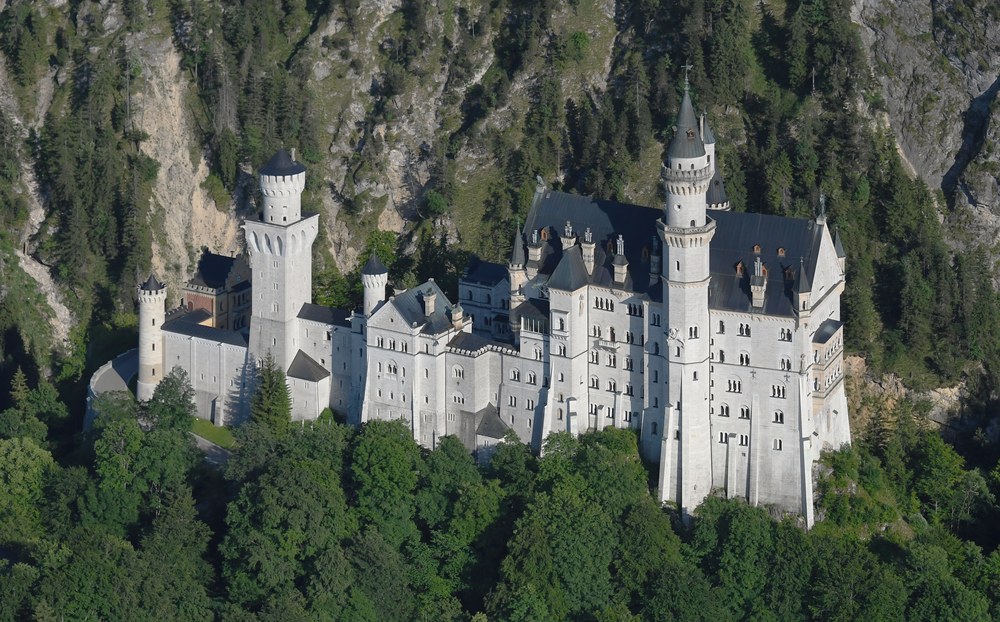 Neuschwanstein from the northwest: the Gatehouse, the Palas, and the Rectangular Tower on the cliff ridge above the Pöllat Gorge. Carsten Steger, CC BY-SA 4.0, via Wikimedia Commons
A stage set in brick and limestone 1869-1886
The foundation stone was laid on 5 September 1869, and the civil works passed from Riedel to Georg von Dollmann in 1874 and to Julius Hofmann in 1884. The palace is conventional brick construction encased in rock: white limestone from a nearby quarry for the fronts, Schlaitdorf sandstone for portals and bay windows, Untersberg marble for windows, arch ribs, columns and capitals. The Throne Hall needed a steel framework. For 1879 to 1880 alone the statistics list 465 tonnes of Salzburg marble, 1,550 tonnes of sandstone, 400,000 bricks and 2,050 cubic metres of scaffolding wood. In 1880 about 200 craftsmen worked on the site, sometimes up to 300 per day, occasionally at night by oil lamp. A workers' insurance society was founded in 1870, and the heirs of 30 construction casualties received small pensions. For all its medieval dress the palace was modern: a battery bell system, telephone lines, hot and cold running water, flush toilets, and central heating. The north stair tower rises 65 metres, and Guinness World Records counts Neuschwanstein as the tallest castle in the world.
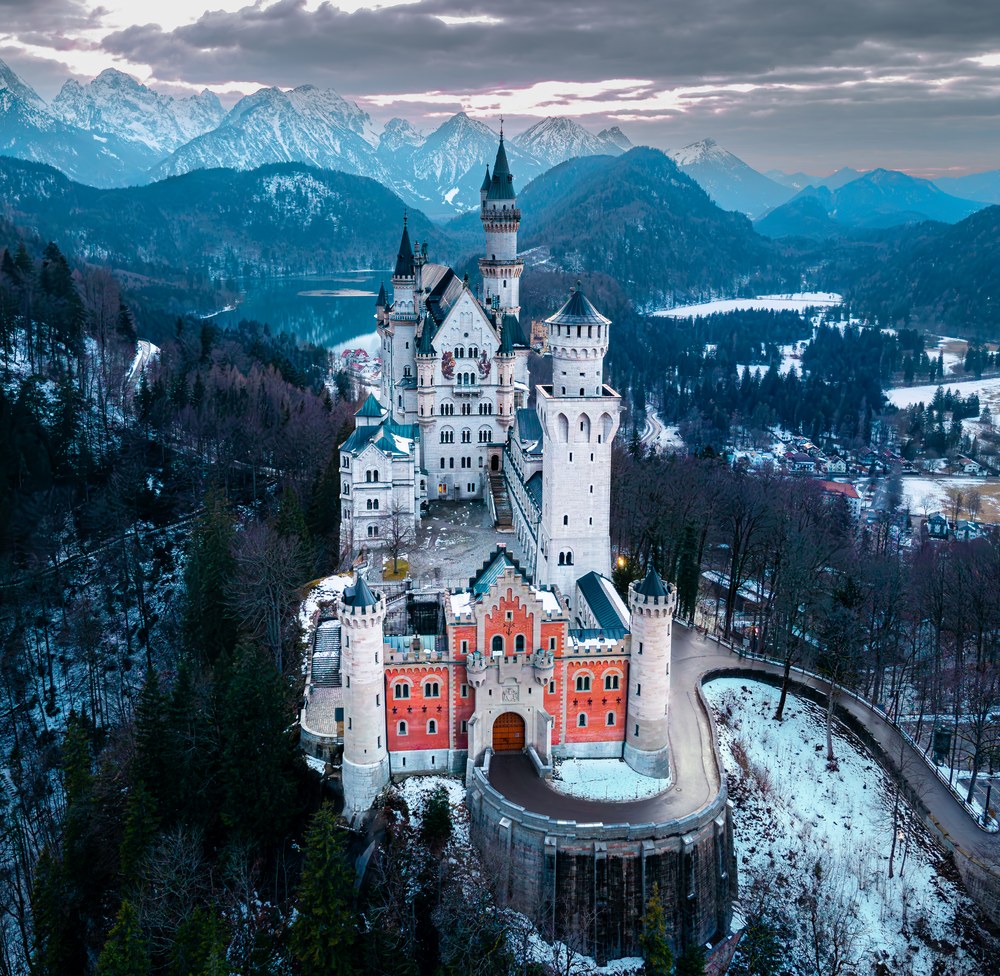 Neuschwanstein at sunset: the five-storey Palas rises on the cliff ridge, with the 65-metre north stair tower above it. Giladtop, CC0, via Wikimedia Commons
The operas in stone
Every room refers to the operas. The Hall of the Singers, 27 by 10 metres and the largest room, is an amalgam of the Wartburg's Hall of the Singers and its Ballroom, decorated with themes from Lohengrin and Parsifal; the reclusive king never meant it for court festivities, only as a walkable monument to knights and courtly love. The Throne Hall, modelled on the Allerheiligen-Hofkirche in the Munich Residenz, surrounds the dais with paintings of Jesus, the Twelve Apostles and six canonised kings: Saint Louis of France, Saint Stephen of Hungary, Saint Edward the Confessor of England, Saint Wenceslaus of Bohemia, Saint Olaf of Norway and Saint Henry. The chandelier is fashioned after a Byzantine crown, and the throne itself was never completed. The hall fuses the Grail Hall from Wagner's Parsifal with the divine right of kings, which Ludwig, as head of a constitutional monarchy, no longer held. The drawing room carries the Lohengrin legend, the study Tannhäuser, the dining room courtly love, and the general decoration the grail legend and Wolfram von Eschenbach as Wagner interpreted them. The artificial grotto between the drawing room and the study depicts the Hörselberg from Tannhäuser, originally with an artificial waterfall and a rainbow machine. The house chapel is consecrated to Saint Louis, after whom Ludwig was named. One reading of this: the swan motifs on the main gate reference the Swan Knight Lohengrin; the common claim that the swan stood for purity in Ludwig's mind comes from tourist literature, not the encyclopedia sources.
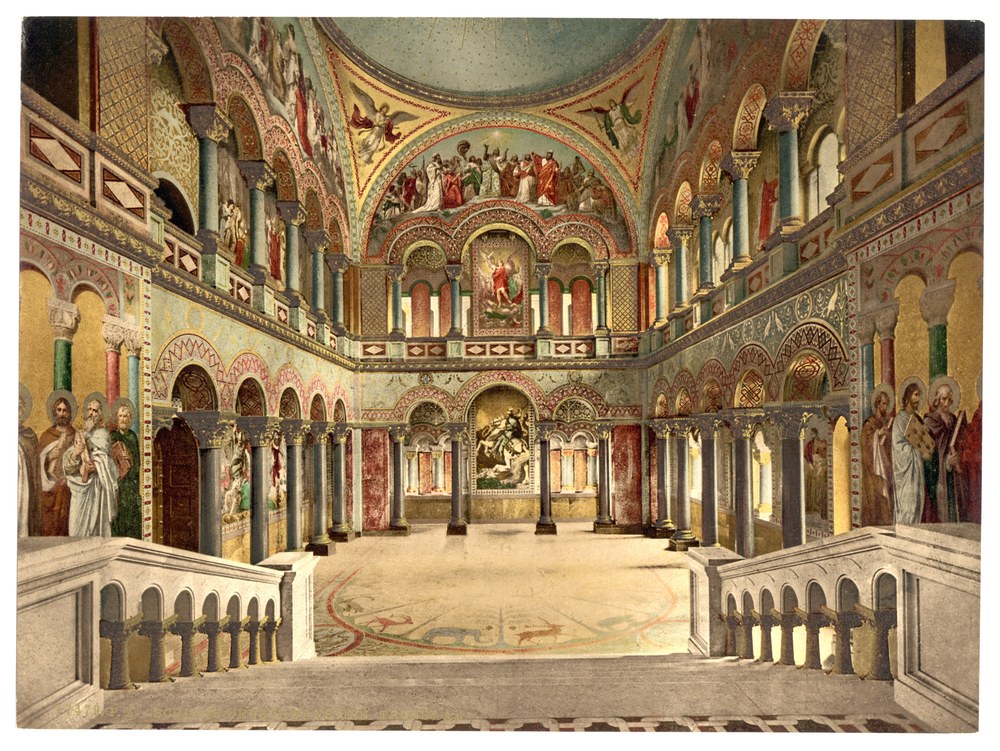 The Throne Hall in a photochrom print from around 1900: the Byzantine-crown chandelier, the arcades, and the apse where the throne was never finished. Photochrom Print Collection, public domain, via Wikimedia Commons
The long finish 1886-2025
The palace was far from complete at the king's death. The Rectangular Tower was still scaffolded. The Bower was completed in simplified form by 1892, without the planned figures of the female saints, and the Knights' House was simplified too. Only the foundations existed for the planned 90-metre keep on a three-nave chapel; its outline is marked in the upper courtyard pavement today. The connection wing between the Gatehouse and the Bower, the Moorish Hall, the Knights' Bath, the Bride Chamber, and the terraced castle garden with a fountain west of the Palas were never built. The floor mosaic of the Throne Hall was completed after the king's death, and in 1886 the wooden Marienbrücke over the Pöllat Gorge was replaced by a steel construction; Ludwig had named the bridge for his mother, Marie of Prussia. The Hall of the Singers stayed silent until 1933, when it hosted its first performance, a concert for the 50th anniversary of Wagner's death. No more than six weeks after the king's death, Prince Regent Luitpold ordered the palace opened to paying visitors, and the estate administrators balanced the construction debts by 1899; until World War I the palace was probably the House of Wittelsbach's single largest revenue source. In 1923, after Bavaria became a republic, the palaces fell to the state and are now managed by the Bavarian Palace Department, a division of the Bavarian finance ministry. From 1944 to the end of the war the castle served as a depot for Nazi plunder taken from France by the Einsatzstab Reichsleiter Rosenberg; 39 photo albums documenting the seizures were found there after the war and are now in the United States National Archives. In April 1945 the SS considered blowing up the palace to keep it and its artworks from the enemy, but the plan was not carried out, and the palace was surrendered undamaged. Today it draws between 1.5 and 1.7 million visitors a year, with up to 6,000 per day in peak season, on 35-minute guided tours with no interior photography. On 12 July 2025 it was inscribed as a UNESCO World Heritage Site, Germany's 55th.
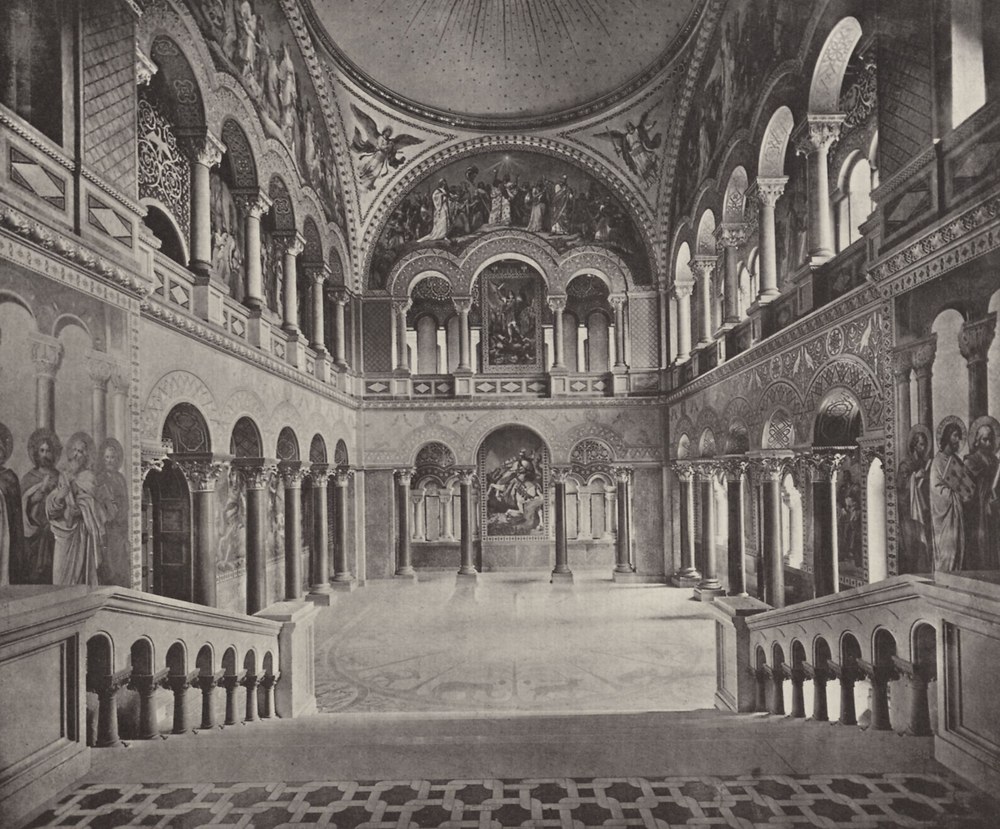 The Hall of the Singers in a 19th-century photograph; the king never used it for court festivities, and its first concert came in 1933. Josef Albert, public domain, via Wikimedia Commons
The fairy tale outlives its king
The fairy tale outlived its king. Critics once derided the palace as kitsch; it is now counted among the major works of European historicism and is the inspiration for Disney's Sleeping Beauty and Cinderella castles. It was a finalist in the 2007 New Seven Wonders of the World online selection, the motif of a 1977 West German definitive stamp, and of a 2012 German 2-euro commemorative coin. It has played itself and others on film: Helmut Käutner's Ludwig II (1955), Luchino Visconti's Ludwig (1972), Chitty Chitty Bang Bang (1968), Spaceballs, and The Great Escape (1963). On 6 April 2002 a meteorite fell near Hohenschwangau and was named Neuschwanstein; three fragments were recovered.
In the cultural conversation 1868-1972
The world's most famous fairy-tale castle began life as a theater set designer's painting. Christian Jank, a Munich scenic painter who had created scenery for Wagner's Lohengrin, was commissioned by Ludwig II to produce the concept designs for his architectural projects, and his theatrical drafts from around 1868 to 1883 are what Neuschwanstein was built from. The origin story explains everything about how it looks.
On screen it is Baron Bomburst's castle in Chitty Chitty Bang Bang (1968), the fortress the flying car swoops over in the film's most memorable aerial sequence. In The Great Escape (1963) the escaping airmen fly their stolen training aircraft past it, believing they are nearly in Switzerland. Both Visconti's Ludwig (1972) and the earlier Ludwig II (1955) filmed on location inside the king's actual castles.
Disney Imagineering executive designer Tony Baxter is on record saying Disneyland's Sleeping Beauty Castle, the 1955 Anaheim icon, was inspired by Neuschwanstein, the moment the castle became the world's default fairy-tale silhouette. Disney's own company account is more hedged, calling the Anaheim castle merely similar and modeled on several medieval castles. A common mix-up names Cinderella Castle instead, but the verified inspiration is the Sleeping Beauty Castle.
Sources: Historical facts adapted from Wikipedia ("Neuschwanstein Castle", CC BY-SA), France 24, Deutsche Welle, National Geographic, and the Bavarian Palace Department. Cultural appearances verified against Wikipedia, BFI, museum collection pages, and production coverage.
Aerial view of the castle from the northwest: Carsten Steger, CC BY-SA 4.0, via Wikimedia Commons
Neuschwanstein Castle at sunset: Giladtop, CC0, via Wikimedia Commons
Throne Hall interior, photochrom print circa 1900: Photochrom Print Collection, public domain, via Wikimedia Commons
Hall of the Singers interior: Josef Albert, public domain, via Wikimedia Commons