The story of Machu Picchu
A 15th-century Inca citadel on a mountain ridge at 2,430 meters, used for about 80 years and abandoned as the empire collapsed. It was never lost to the locals; Hiram Bingham simply told the world about it in 1911.
The emperor's retreat
Machu Picchu is the best-known surviving work of Inca urbanism: a royal estate of the emperor Pachacuti, built around 1450 to 1470 after his conquest of the middle and lower Urubamba, as part of a broader program of royal estates along the river. Radiocarbon dating of human remains places occupation around 1420 to 1530, slightly earlier than traditional documentary chronologies. It was used for about 80 years and abandoned in the mid-16th century as Inca rule collapsed. During its life it housed about 750 people, mostly yanaconas, support staff living there permanently, plus religious specialists. Skeletal and genome-wide studies show the retainer community was strikingly diverse: Andean, coastal, Ecuadorian, and Amazonian ancestries, people who had moved there from far regions and were buried together. The 4.9 hectares of terraces could not feed them all, so food was partly imported.
 The citadel on its ridge at 2,430 meters, with Huayna Picchu behind. Diego Delso, CC BY-SA 4.0, via Wikimedia Commons
The name nobody knew
The original Inca name is not definitively known. A 2021 study in Nawpa Pacha argues it was likely called 'Huayna Picchu' after the smaller peak, or simply 'Picchu,' and that the name Machu Picchu stuck from Hiram Bingham's 1911 publications. What is certain is that the site was never 'lost' to the people who lived there. Two Quechua farming families, the Richarte and Alvarez families, were living on cleared terraces when Bingham arrived. Peruvian explorer Agustin Lizarraga had reached it in 1902 and left his name and the year in charcoal on the central window of the Temple of the Three Windows, nine years before Bingham's arrival on 24 July 1911, when local villager Melchor Arteaga led the Yale lecturer up the ridge. Bingham credited Lizarraga as the discoverer in his early writings but later downplayed him, claiming the discovery for himself.
A sacred landscape in stone
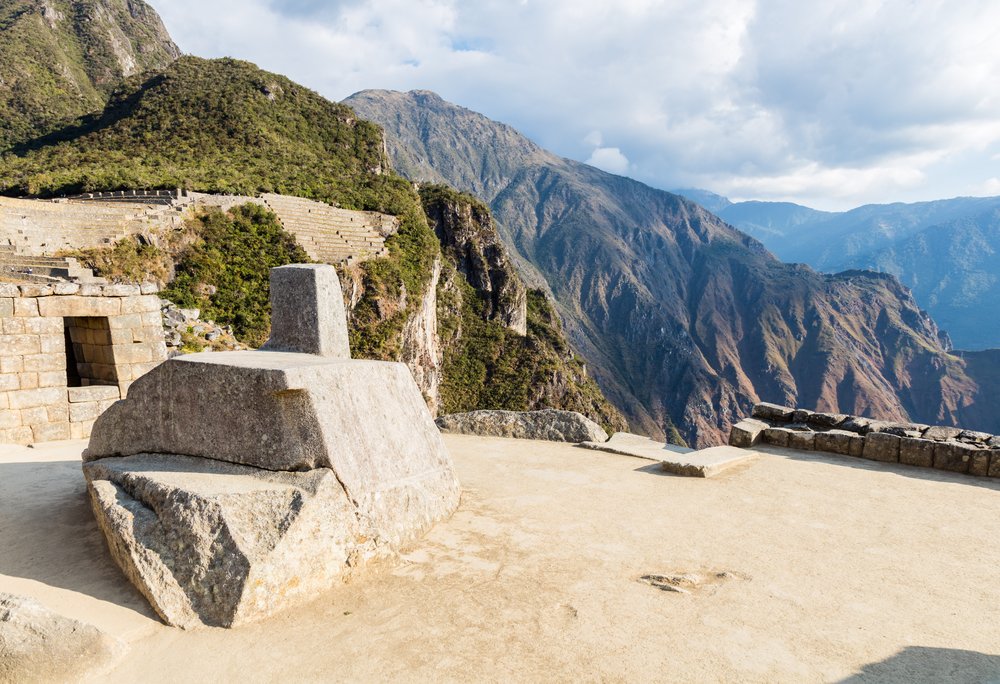
The Intihuatana, 'the place where the sun is tied,' is a ritual stone carved from a natural granite outcrop on a terraced hill in the upper Hanan sector. It points at the sun during the winter solstice; on November 11 and January 30 the midday sun stands nearly directly above it, and on June 21 it casts its longest southern shadow. Scholars reject the popular idea that it was a calendar gnomon; its placement within a sacred landscape may hold symbolic significance [interpretation, supported by the cited studies]. On 8 September 2000 a 450-kilogram camera crane fell onto it during a beer commercial shoot, chipping a corner of the stone. The Temple of the Sun, the Torreon, is the only Inca construction with a semicircular shape, about 10.5 meters across, with solar-aligned openings and a 'Serpent's Door' leading to a platform with a view of Huayna Picchu. The Temple of the Three Windows holds three oversized trapezoidal openings with lintels and jambs each carved from single stones, aligned to the solstices and the equinox; one reading treats the three windows as the three Inca worlds, Hanan-Pacha, Kay-Pacha, and Ukju-Pacha [interpretation]. Inti Mach'ay, a cave on the slope, lets sunlight in for only a few days around the December solstice, when noble boys were initiated into manhood there. The Temple of the Condor centers on a carved stone read as a condor in flight [interpretation], and camelid remains suggest ritual animal sacrifice. The Room of the Mortars, once proposed as water mirrors for astronomy, is now thought by 2022 studies to have had no calendrical function at all; its purpose remains uncertain.
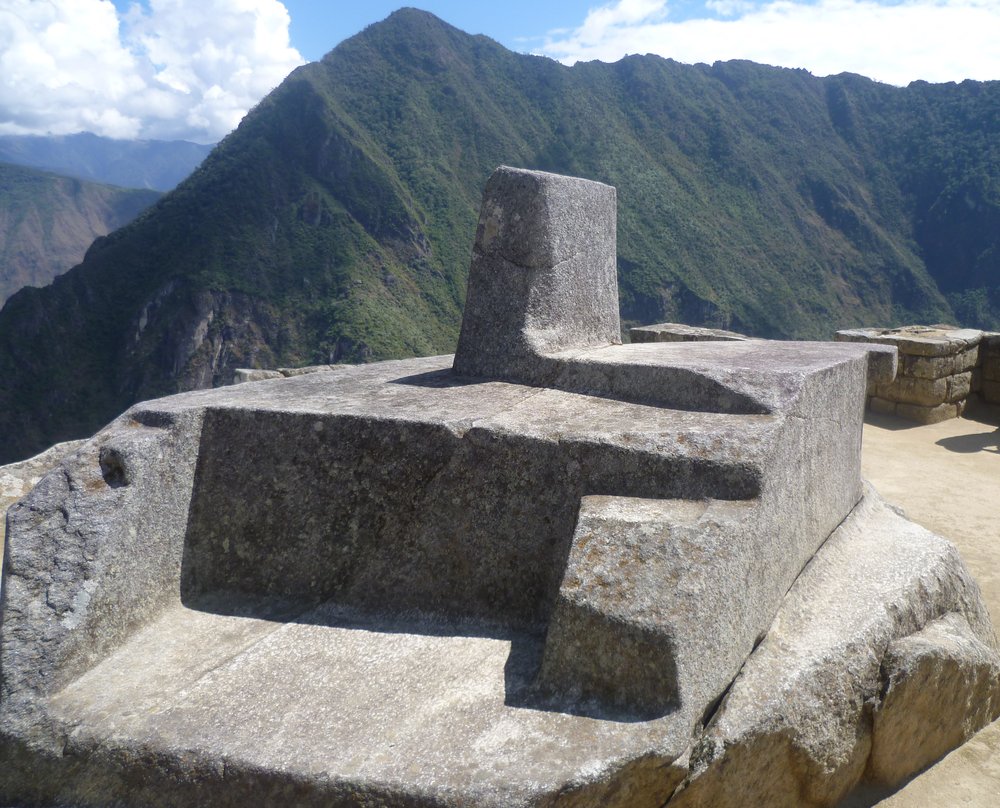 The Intihuatana, the 'hitching post of the sun,' carved from the mountain bedrock. Alesegura, CC BY-SA 4.0, via Wikimedia Commons
Water and walls
The construction is classical Inca dry-stone masonry: finely fitted stones with no mortar, trapezoidal doorways and windows, and inward-leaning walls that ride out earthquakes. The terraces, the andenes, serve agriculture and erosion control at once. Water came from a spring on the mountain slope through a stone-lined canal about 749 meters long, 10 to 12 centimeters wide, with about a 3 percent slope and a design capacity of about 300 liters per minute. Sixteen stone fountains, the Stairway of Fountains, descend through the citadel with a total drop of about 26 meters from fountain 1 to fountain 16; the first fountain stood adjacent to the emperor's residence, a mark of privileged access. About 130 outlet drains pierce the retaining walls. One geologist has argued the city was intentionally built on fault lines for natural drainage and fractured building stone One reading of this: this is one geologist's thesis, not consensus.
The Yale dispute
The 1912, 1914, and 1915 expeditions cleared and excavated the site, and Bingham removed thousands of artifacts to Yale, legal under Peru's 1852 Civil Code, which gave finds to the discoverer. After accusations of smuggling, a century-long dispute ended only in 2011 and 2012, when Yale returned the artifacts in three batches. They are now exhibited at the Machu Picchu Museum, Casa Concha, in Cusco.
The science goes on
The research continues. A 2021 study led by Yale anthropologist Richard Burger used 26 AMS radiocarbon dates on human remains to place occupation around 1420 to 1530. Systematic excavations, pollen studies, and architectural analyses from 2014 to 2017 clarified the construction phases. A 2017 to 2019 study of the Principal Plaza showed it evolved from a natural drainage basin to a quarry, then a smaller sunken plaza, before being raised and expanded in at least two phases. Detailed laser scans of the whole site were made in 2005 and 2009.
The world's most visited mountain
Peru declared the Historic Sanctuary of Machu Picchu in 1981; UNESCO inscribed it in 1983; in 2007 it won a place among the New 7 Wonders of the World. It is Peru's most visited site: over 1.5 million visitors in 2025. Tourism has scarred it at times: in the 1980s a rock was moved to create a helicopter landing zone; the 2000 crane accident chipped the Intihuatana; nude tourism in 2014 brought increased surveillance. UNESCO considered a World Heritage in Danger listing in 2017 over overcrowding but decided against it. Stricter entrance rules capped visitors at 2,500 per day in 2011, and the daily limit was raised to 4,500 in 2024, up to 5,600 in peak season.
In the cultural conversation 1913-2024
The single most consequential piece of writing in the site's cultural history is a magazine issue. The entire April 1913 number of National Geographic was devoted to Hiram Bingham's expeditions, with photographs including a triple-foldout panorama; it introduced Machu Picchu to a mass global audience, broke the magazine's circulation records, and made Bingham a celebrity.
Hollywood arrived in 1954, when Paramount's Secret of the Incas, starring Charlton Heston, became the first major studio film shot at the site. Werner Herzog opened Aguirre, the Wrath of God (1972) in the Machu Picchu area, and Walter Salles gave the citadel a prominent place in the 1952 journey of The Motorcycle Diaries (2004).
The modern blockbuster era has kept it in front of huge audiences: Transformers: Rise of the Beasts (2023) filmed sequences at the citadel over several months in 2021, and Paddington in Peru (2024) made it the story's central Inca-ruin location. In 2007 Machu Picchu was voted one of the New 7 Wonders of the World. No famous easel painting of the site in a known collection could be verified.
Sources: Historical facts adapted from Wikipedia ('Machu Picchu', CC BY-SA) and Smarthistory. Cultural appearances verified against Wikipedia, BFI, museum collection pages, and production coverage.
Panoramic view with Huayna Picchu: Diego Delso, CC BY-SA 4.0, via Wikimedia Commons
The Intihuatana ritual stone: Alesegura, CC BY-SA 4.0, via Wikimedia Commons