The story of the London Eye
A 135-meter observation wheel on the South Bank, built to mark the year 2000. It was supposed to last five years; it became the most popular paid tourist attraction in Britain, and it never came down.
A wheel for the year 2000
The idea belonged to two architects with a tiny practice. David Marks and Julia Barfield, a husband-and-wife team who met in 1972 at the Architectural Association, founded Marks Barfield Architects in 1989. In the early 1990s recession the firm survived on kitchen extensions and brochure design. In 1993 they entered a Sunday Times and Architecture Foundation competition for a landmark to commemorate the third millennium. Marks, inspired by views of the BT Tower on his daily commute, imagined a wheel that would get people up high easily, efficiently, and effortlessly; Barfield suggested the South Bank, the site of the Festival of Britain fifty years earlier. The judges, including Norman Foster, gave the competition no winner: no proposal was deemed sufficiently imaginative. The original name was the Millennium Wheel, and the millennium was the point: Barfield later framed it as being about welcoming the 21st century into London.
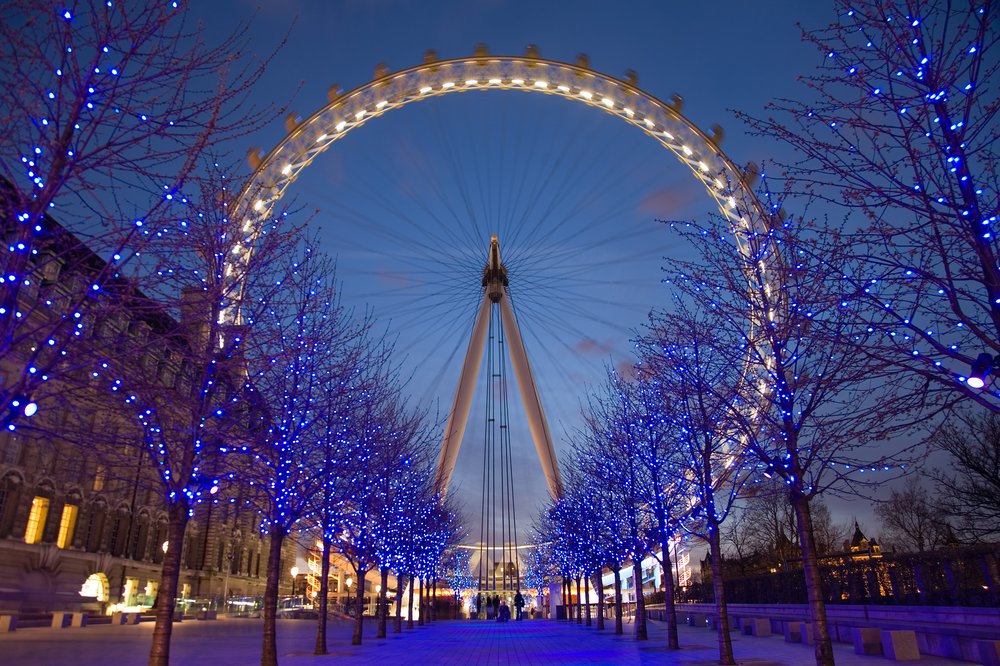 The 135-meter wheel at twilight, supported by its A-frame from one side only. Diliff, CC BY 2.5, via Wikimedia Commons
Buying a dream
Undeterred, Marks and Barfield remortgaged their home and applied for planning permission. In the summer of 1994 the Evening Standard's editor Stewart Steven and correspondent Mira Bar-Hillel launched a 'Back The Wheel' public campaign. That December, Bob Ayling, chief executive of British Airways and a neighbor of the architects, persuaded the airline to invest 600,000 pounds in seed funding, and Marks Barfield commissioned detailed engineering from Arup. British banks declined to finance the project; the money came instead from the German bank Westdeutsche Landesbank and the Japanese conglomerate Sumitomo Corporation. Planning permission was granted in 1996.
Raised over the Thames
The build was pan-European. Hollandia in the Netherlands fabricated the steel, the cables came from Italy, the bearings from Germany, the spindle and hub were cast in the Czech Republic, Poma in France built the capsules, and the capsule glass came from Italy. The rim sections were floated up the Thames on barges and assembled lying flat on piled platforms in the river. The complete wheel was then raised by strand jacks. The first attempt, on 10 September 1999, failed during a 110 percent load test when sockets holding the temporary cables slipped; two cables came loose at about 90 percent loading and splashed into the Thames in front of television crews. Project director Tim Renwick later said the team went out and got drunk that night, and got back to work the next day. The redesigned anchor plates passed testing, and the second lift, in October 1999, raised the wheel to 65 degrees and then to vertical, in what engineers called the biggest structure ever lifted in that manner.
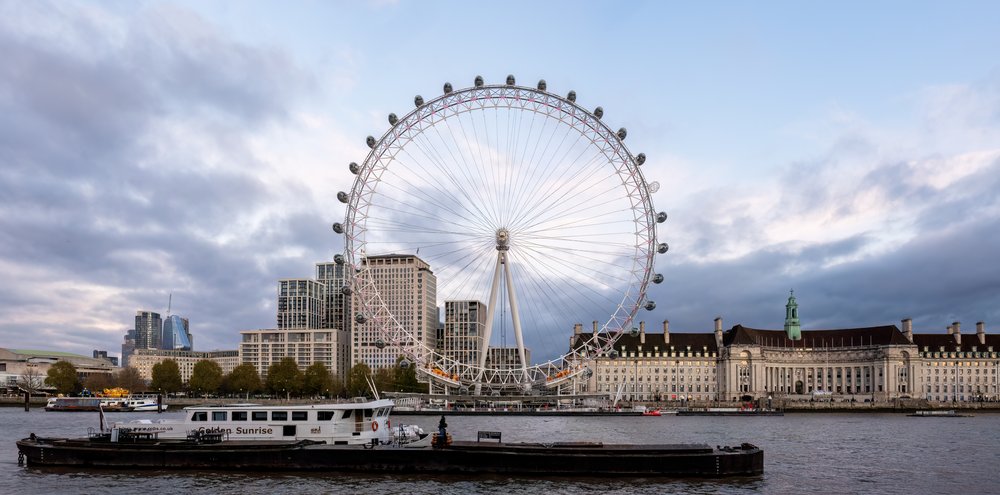 The 120-meter steel rim with its spoke cables and ovoidal capsules. Rhododendrites, CC BY-SA 4.0, via Wikimedia Commons
Five years that became permanent
The Eye was formally opened on 31 December 1999 by Prime Minister Tony Blair, who fired a laser across the Thames, with a Concorde flypast. A capsule clutch problem delayed paying passengers until 9 March 2000. It had been built with only a five-year lease and designed to be unbolt-able and movable, but it proved so popular that Lambeth Council granted permanent status in July 2002; 3.5 million visitors had come in the first ten months. In 2005 and 2006 the Southbank Centre demanded the rent rise from 65,000 pounds to 2.5 million pounds a year; Mayor Ken Livingstone threatened a compulsory purchase order, and a 25-year lease was agreed in February 2006. Tussauds bought British Airways' share in 2005 and Marks Barfield's in 2006, gaining sole ownership; Tussauds later merged into Merlin Entertainments, the current owner.
The wheel's parts
The Eye is 135 meters tall with a steel rim 120 meters across, the world's tallest cantilevered observation wheel: it is supported on one side only, like one fork of a bicycle. A fixed spindle 22 meters long cantilevers out over the Thames, founded on the shore and anchored back to a tension foundation. The A-frame has two tapered legs, each over 58 meters long and 20 meters apart at the base, leaning toward the river at 65 degrees, with cable backstays buried in a concrete foundation 33 meters deep. Sixty-four tensioned steel cables, the spokes, connect hub and rim, each prestressed to 75 tonnes; the wheel's full dead load hangs on them. Computer-controlled hydraulic motors drive tires against the rim. The 32 sealed, air-conditioned ovoidal capsules hang on the outside of the rim, each weighing 10 tonnes and holding up to 25 people; each represents one of the London boroughs, and they are numbered 1 to 33, skipping 13 for superstitious reasons. The wheel turns at 26 centimeters per second, one revolution in about 30 minutes, and it does not usually stop: the speed lets passengers walk on and off the moving capsules at ground level.
The Eye at work
It is the most popular paid tourist attraction in the United Kingdom, with more than three million visitors a year, and it had carried more than 85 million passengers as of 2025. Each New Year's Eve the Eye is the focal point of London's celebrations, with more than 2,000 fireworks launched from the wheel itself. It lit blue for the Clap for our Carers campaign in 2020, and it illuminates for the crescent-moon sighting of Shawwal marking Eid al-Fitr. At least 6,000 wedding proposals had taken place on the attraction as of 2025. The naming rights have changed hands without touching the structure: British Airways, Merlin, EDF Energy, Coca-Cola, and lastminute.com. The lighting was redone with LEDs from Color Kinetics in December 2006 for digital control of the colors, and a 12.5 million pound capsule upgrade began in 2009, with each capsule floated down the Thames to Tilbury Docks. On 2 June 2013 a capsule was named the Coronation Capsule for the 60th anniversary of Queen Elizabeth II's coronation.
In the cultural conversation 2005-2007
The Eye's defining screen role came in Doctor Who: Rose (2005), the episode that relaunched the series. Rose identifies the wheel as the transmitter of the Nestene Consciousness, and the climax plays out at and beneath the structure, ending the first episode of the revived era with the Eye as the villain's machine.
In Fantastic Four: Rise of the Silver Surfer (2007) the Silver Surfer opens a crater by Westminster Bridge that dislodges the Eye, and the team scrambles to stop the attraction collapsing into the Thames, the closest the wheel gets to a full action set-piece. Opened in 2000, the Eye has not entered the canon of famous easel paintings; its visual identity is photographic and screen-based.
Sources: Historical facts adapted from Wikipedia ('London Eye', CC BY-SA) and New Civil Engineer. Cultural appearances verified against Wikipedia, BFI, museum collection pages, and production coverage.
The London Eye at twilight: Diliff, CC BY 2.5, via Wikimedia Commons
Close view of the wheel and capsules: Rhododendrites, CC BY-SA 4.0, via Wikimedia Commons