The story of Himeji Castle
Himeji Castle is Japan's finest surviving feudal castle: a 46-meter white keep on Himeyama hill that survived 700 years, a war, and an earthquake without ever facing a battle. This is the story it kept.
Four centuries on the hill 1333-1609
Himeyama hill was first fortified in 1333 by Akamatsu Norimura during the Genko War; his son Sadanori demolished the fort and built Himeyama Castle in 1346. Two centuries later the site became Himeji Castle under Kuroda Shigetaka, and in 1580 Kuroda Yoshitaka presented it to Toyotomi Hideyoshi, who expanded it with a three-story keep in 1581. After the Battle of Sekigahara in 1600, Tokugawa Ieyasu granted the castle to his son-in-law Ikeda Terumasa, who demolished Hideyoshi's keep and completely rebuilt and expanded the castle from 1601 to 1609, adding three moats and creating the complex seen today, at an estimated 2.5 million man-days of labor. In 1617 and 1618 Honda Tadamasa added several buildings, including the kesho yagura, the Dressing Tower, a special tower for his daughter-in-law Princess Sen.
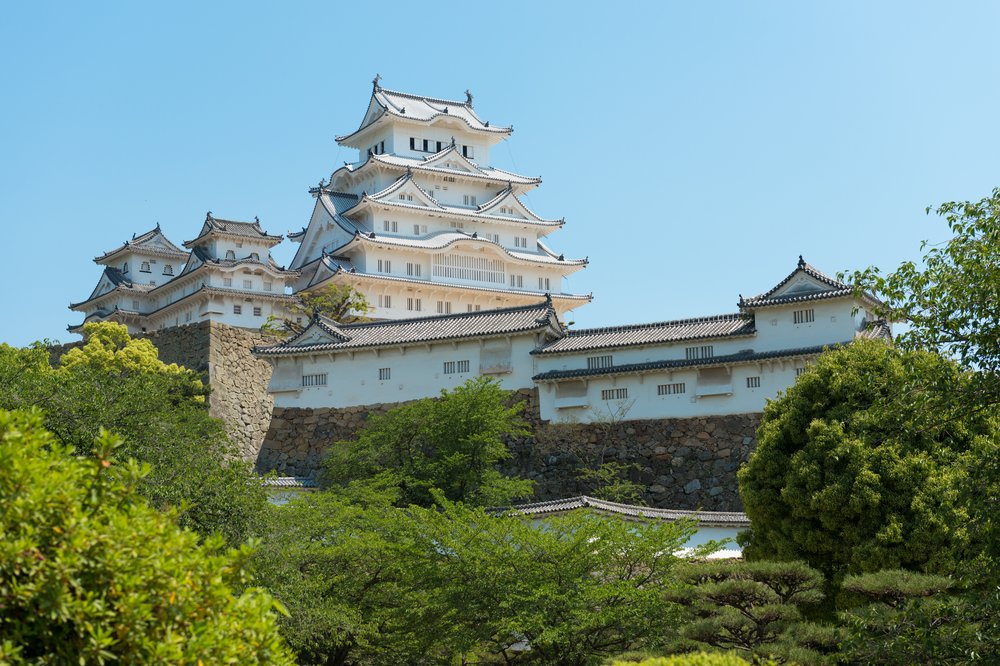 The main keep after the 2010-2015 restoration returned its grey walls to brilliant white. Nikos Kitsakis, CC BY-SA 4.0, via Wikimedia Commons
The white egret
The brilliant white plaster exterior gave the castle its nicknames Hakuro-jo and Shirasagi-jo, the White Egret or White Heron Castle, for its supposed resemblance to a bird taking flight. The comparison is popular lore, not documented design intent. The plaster itself was chosen for a harder reason: thick sand-and-clay walls bound with rice glue are fire-resistant, and contemporary accounts say they were impenetrable to matchlock balls. The white egret, then, is beauty as a side effect of survival engineering. Decades of grime had dulled the walls to grey; the 2010 to 2015 restoration cleaned the roofs and plaster and returned them to white. The castle reopened on 27 March 2015 and drew 2.86 million visitors that year.
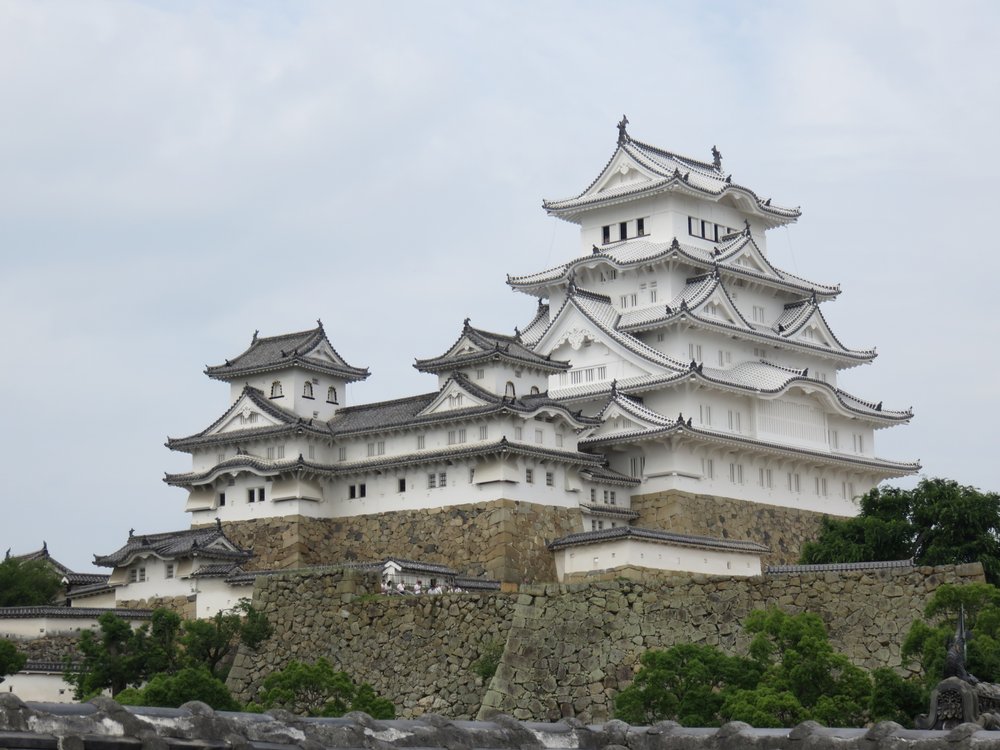 The keep tower close up: shachihoko roof ornaments, gables, and the brilliant white plaster. Terumasa, CC BY-SA 4.0, via Wikimedia Commons
A maze that never fought
The castle's defenses were never battle-tested. The maze-like spiral approaches were designed to confuse and expose intruders: the straight-line distance from the Hishi Gate to the main keep is about 130 meters, but the walk is about 325 meters of steep, narrow, deliberately misaligned passages and dead ends. Attackers would meet roughly 997 firing holes in circle, triangle, square, and rectangle shapes (a reported figure, from a single source), stone-drop windows angled to rain rocks and boiling water or oil, and warrior hiding places built into the corners of each keep floor. One reading of this: the maze also enacts the feudal order itself, with power receding behind layer after layer of controlled access. The complex holds 83 buildings; the outer moat is now buried, and 21 of the original 84 gates remain intact.
Inside the keep
The main keep stands 46.4 meters high, and 92 meters above sea level. It looks like five floors from outside; it actually has six plus a basement. The first floor covers 554 square meters, the 'thousand-mat room' with more than 330 tatami mats; its weapon racks once held 280 guns and 90 spears. Two great pillars carry the structure: the east pillar has a base diameter of 97 centimeters and was originally a single fir tree; the west pillar base is 85 by 95 centimeters of Japanese cypress. In the 1956 to 1964 Showa restoration the west pillar was replaced with a 26.4-meter cypress from the Kiso Mountains; the tree broke in handling, so a second tree from Mount Kasagata was joined to it on the third floor. The top floor houses a small shrine and gives panoramic views over the city.
Saved from demolition
In the Meiji period castles were obsolete, and the government slated Himeji for demolition. Army colonel Nakamura Shigeto's efforts spared it; a stone monument honoring him stands inside the first gate, the Hishi Gate. The castle was abandoned in 1871, briefly served as the 10th Infantry Regiment headquarters in 1874, and preservation efforts began in 1877, with government funding from 1910. In 1945 Himeji was heavily bombed; the castle survived intact, and one firebomb dropped on the top floor failed to explode. The Showa restoration of 1956 to 1964 took 250,000 man-days and 550 million yen. In January 1995 the Great Hanshin earthquake devastated Himeji city but the castle survived virtually undamaged, a demonstration of remarkable earthquake resistance; even a sake bottle on the altar of the keep's top floor stayed in place. On 11 December 1993 it was inscribed as one of Japan's first UNESCO World Heritage Sites.
The castle's ghosts
The building carries four legends, and each is folklore, not history. Okiku's Well: the Banshu Sarayashiki ghost story of the maid Okiku and the ten plates claims the castle as its true location, and the old stone-lined well remains in the castle. The Ubagaishi, the Old Widow's Stone: when Hideyoshi ran short of stones for his 1581 keep, an old woman gave her hand millstone, inspiring others to donate stones; the supposed stone is visible under a wire net in one wall. Sakurai Genbei, Ikeda's master carpenter, supposedly felt the keep leaned to the southeast and threw himself from the top with a chisel in his mouth. And the castle is said to be inhabited by the yokai Osakabehime, who lives in the tower, avoids humans, reads minds, and commands lesser animal-like yokai. A 2023 Lego Architecture model of 2,125 pieces is the latest tribute, in plastic rather than plaster.
In the cultural conversation 1926-1985
Western audiences know the castle best as Tiger Tanaka's ninja training school in You Only Live Twice (1967), where Sean Connery's Bond trains. Akira Kurosawa shot two of his late epics there: in Ran (1985) Himeji served as the warlord Hidetora's first and second castles, with blood effects composited optically afterward because none could be shed on the floors of a national treasure, and in Kagemusha (1980) it appears as the castle of the warlord Oda Nobunaga.
The definitive printed image is Hiroshi Yoshida's 1926 shin-hanga pair, Himeji Castle, Morning and Himeji Castle, Evening, made for international audiences of Japanese art. Okumura Togyu, one of the 20th century's major nihonga masters, painted Himeji Castle around 1955 after spending a week sketching during the keep's landmark dismantling and restoration; the work is in the Yamatane Museum of Art in Tokyo.
One credit the castle does not deserve: The Last Samurai (2003) filmed its Himeji scenes at Engyoji Temple on Mount Shosha, in Himeji city, not at the castle itself.
Sources: Historical facts adapted from Wikipedia ('Himeji Castle', CC BY-SA), UNESCO, and the Himeji Castle Guide (Himeji Rojyo Lions Club). Cultural appearances verified against Wikipedia, BFI, museum collection pages, and production coverage.
The keep after the 2010-2015 restoration: Nikos Kitsakis, CC BY-SA 4.0, via Wikimedia Commons
Keep tower close view after restoration: Terumasa, CC BY-SA 4.0, via Wikimedia Commons