The story of the Empire State Building
For 39 years the tallest building in the world, it rose from a demolished hotel in just over a year during the Great Depression. The story of the race to build it, the fame that followed, and the lights that still signal the city.
The race into the sky 1929-1931
While the Empire State was being planned, the race for the world's tallest building was already dirty. 40 Wall Street was revised upward to 925 ft, and the Chrysler Building secretly added a 185 ft steel spire in October 1929, reaching 1,046 ft. Chrysler's architect William Van Alen had swapped a stubby Romanesque dome for the spire on Walter Chrysler's orders. John J. Raskob, determined the Empire State would be tallest, added five floors and a spire of his own. Fearing Chrysler might pull one more trick, the plans were revised a final time in December 1929 to add a 16-story, 200 ft metal crown plus a 222 ft mooring mast for dirigibles. Roof height: 1,250 ft, the world's tallest by far. The blueprints went through up to fifteen versions.
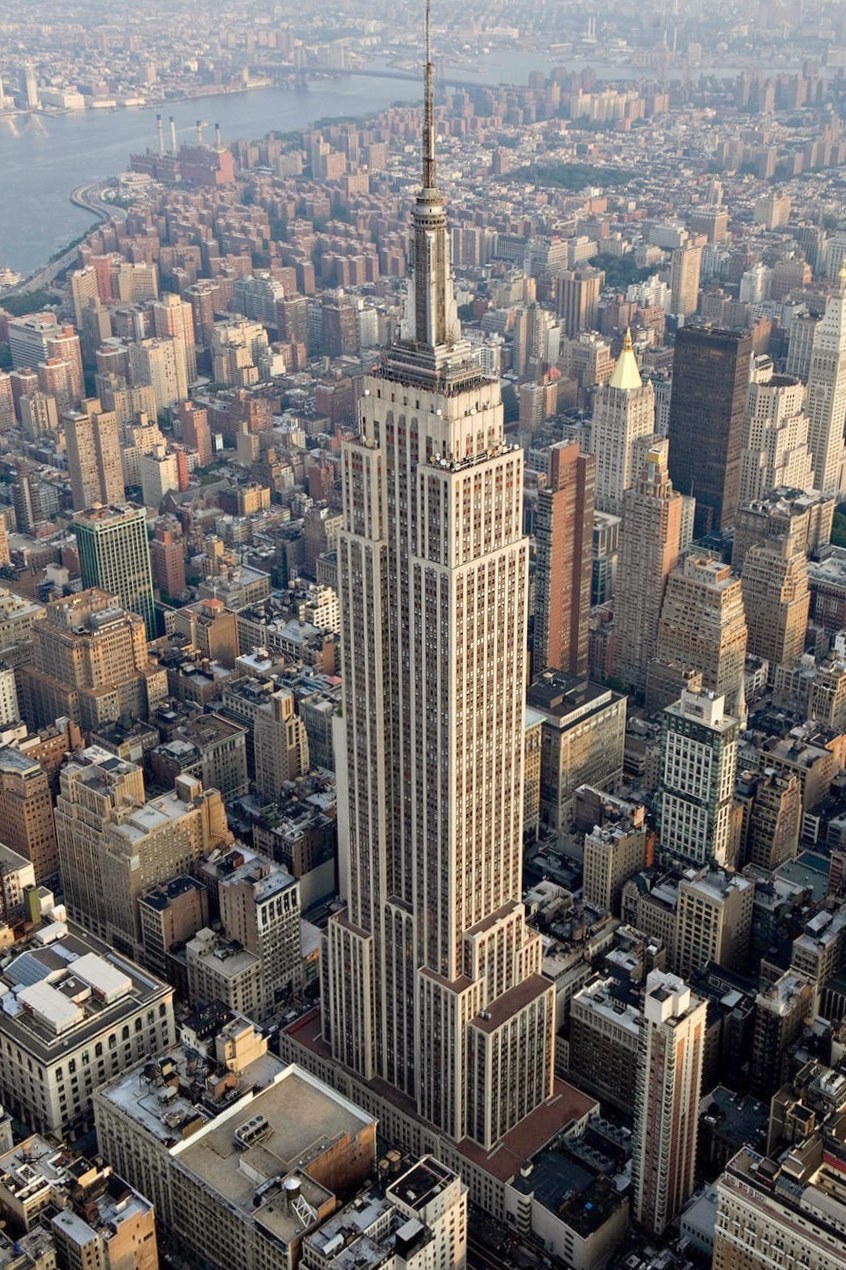 The completed tower rising over Midtown Manhattan. Sam Valadi, public domain, via Wikimedia Commons
Building through the crash 1930-1931
Demolition of the Waldorf-Astoria Hotel began on 1 October 1929, weeks before Black Tuesday. Raskob refused to cancel. In December 1929 Empire State Inc. took a $27.5 million loan from Metropolitan Life, and construction started on 17 March 1930. It ran at up to four and a half stories a week, with 3,500 workers at peak: many Irish and Italian immigrants, plus Mohawk ironworkers from Kahnawake. The 57,480-ton steel order was the largest single steel order ever placed. Lewis Hine photographed the construction, climbing out onto the steel with the ironworkers. Official accounts list five worker deaths; contemporary press reports suggested more. Total cost: $40,948,900, under the $60 million budget. Al Smith drove the final, solid-gold rivet on 11 April 1931, twelve days ahead of schedule.
The empty state 1931
On 1 May 1931 President Herbert Hoover pressed a button in Washington, D.C. to light the building. Guests included Governor Franklin D. Roosevelt and Mayor Jimmy Walker. The building opened into the Depression: in its first year only 23 percent of space was rented, earning the nicknames "Empty State Building" and "Smith's Folly." Lights were left on in empty floors to fake occupancy. It did not turn a profit until the early 1950s. The observation deck carried the building: 1 million visitors at $1 each in 1931 made about $2 million, as much as rents in year one.
The mooring mast that never moored 1931
The spire was meant as a dirigible terminal, with ticketing on the 86th floor and airships tying up at the equivalent of the 106th floor. On 15 September 1931 a U.S. Navy airship circled 25 times in 45 mph winds, tried to dock, spilled ballast, and was rocked by eddies. The near-disaster killed the plan. One blimp later managed a single newspaper delivery. The mast instead became a broadcasting antenna, a use that defines it to this day: NBC and RCA began experimental television from the mast in December 1931, and Edwin Howard Armstrong tested the world's first FM transmitter there in 1934. One reading of this: the mooring mast reads as 1920s techno-optimism meeting physics, and its afterlife as a broadcast antenna as a failed future repurposed into mass media.
King Kong and the camera 1933
The film's climax, with Kong atop the still-new building, made it a cinematic icon. It has since appeared in more than 250 films and TV series: An Affair to Remember, Sleepless in Seattle, Independence Day, Andy Warhol's 1964 film Empire. The American Society of Civil Engineers named it one of the Seven Wonders of the Modern World, and in 2007 the American Institute of Architects ranked it first in its list of America's Favorite Architecture. Around 4 million people a year visit its observatories. It even has its own ZIP code: 10118.
A green old giant 2009-2020
A $550 million renovation from 2009 included $120 million for energy efficiency, with a 38 percent emissions-reduction target: all windows were refurbished in place as film-coated "superwindows," earning LEED Gold for Existing Buildings in September 2011. A $160 to 165 million observatory redesign in 2018 and 2019 added the 80th-floor observatory, floor-to-ceiling glass on the 102nd, and a 10,000 sq ft exhibit. The mast was restored in 2019 and 2020, with antennas removed or relocated and aluminum panels cleaned and recoated, all done at night to avoid disrupting the decks. Ownership changed hands repeatedly: sold in 1951 for $51 million, bought in 1961 by Lawrence Wien and Harry Helmsley for $65 million through 3,000 small investors at $10,000 a share, and taken public as Empire State Realty Trust in 2013, with the Qatar Investment Authority taking a 9.9 percent stake in 2016.
Bonus download: AI concept poster
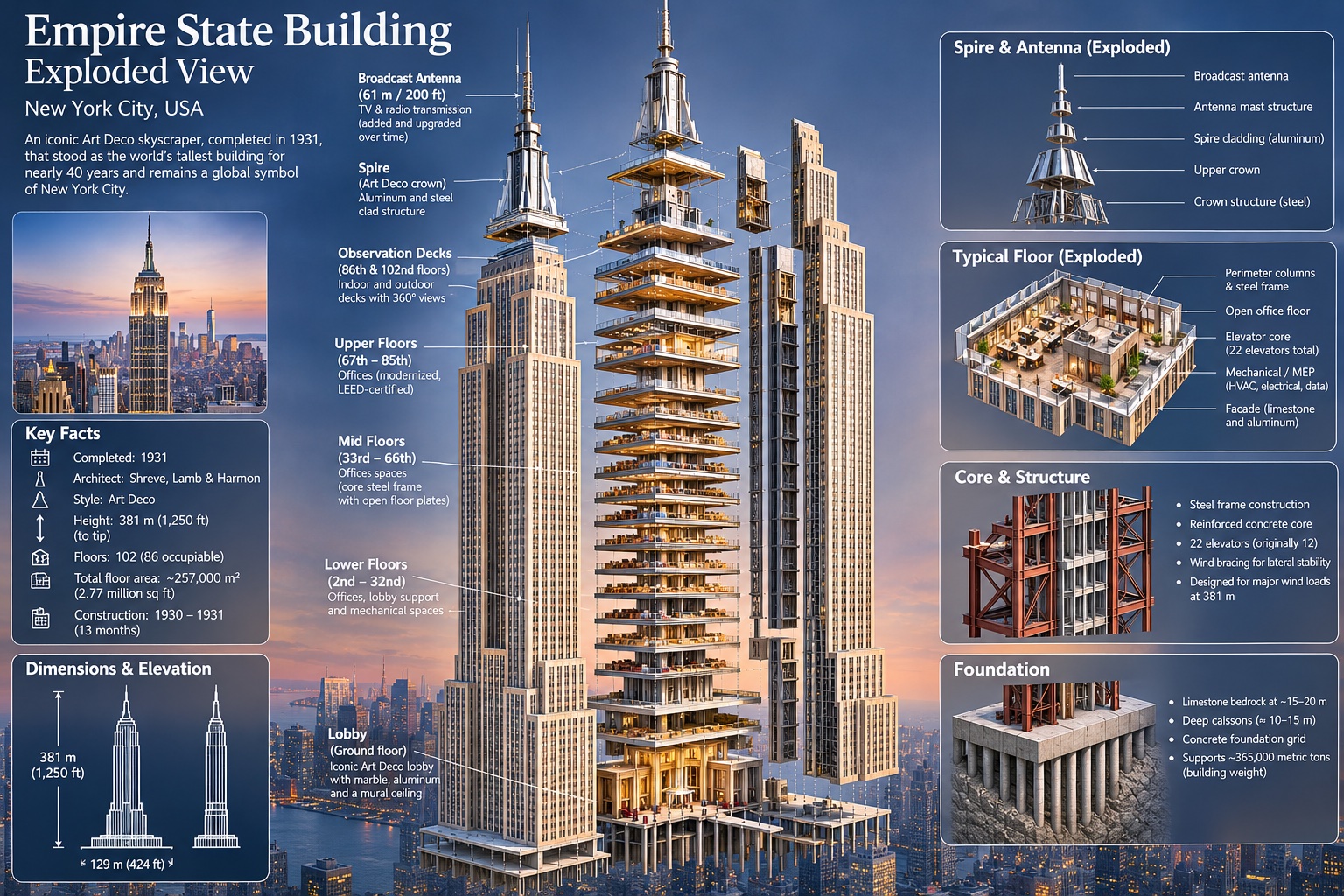 An AI-generated poster of the exploded Empire State Building (ChatGPT). An artistic impression, not the verified Atlas poster: the elevator count reads 22 here; the building has 73 elevators. The verified story is above.
Download the poster (JPG, 1536 x 1024)
Sources: Historical facts adapted from Wikipedia ("Empire State Building", CC BY-SA), Structurae, and the ESB tower-lights schedule aggregated on the Atlas leaderboard.
Panoramic view of the tower and Midtown Manhattan: Daniel Schwen, CC BY-SA 4.0, via Wikimedia Commons
The Empire State Building in 2012: Dietmar Rabich, CC BY-SA 4.0, via Wikimedia Commons
Aerial view of the building: Sam Valadi, public domain, via Wikimedia Commons