The story of the Burj Khalifa
At 829.8 m the tallest building and tallest structure in the world: a Y-shaped tower of 27 spiraling setbacks, built with 22 million man-hours, renamed at its own opening for the ruler who bankrolled Dubai's debts.
The diversification gamble 2003-2004
The tower was conceived as the centerpiece of a large-scale mixed-use development: 30,000 homes, nine hotels, parkland, the Dubai Mall, and the 12-hectare Burj Khalifa Lake across 2 km2 of Downtown Dubai. The decision to build it was reportedly based on the government's decision to diversify from an oil-based economy to one based on services and tourism. "He (Sheikh Mohammed bin Rashid Al Maktoum) wanted to put Dubai on the map with something really sensational," said Jacqui Josephson, a tourism and VIP delegations executive at Nakheel Properties.
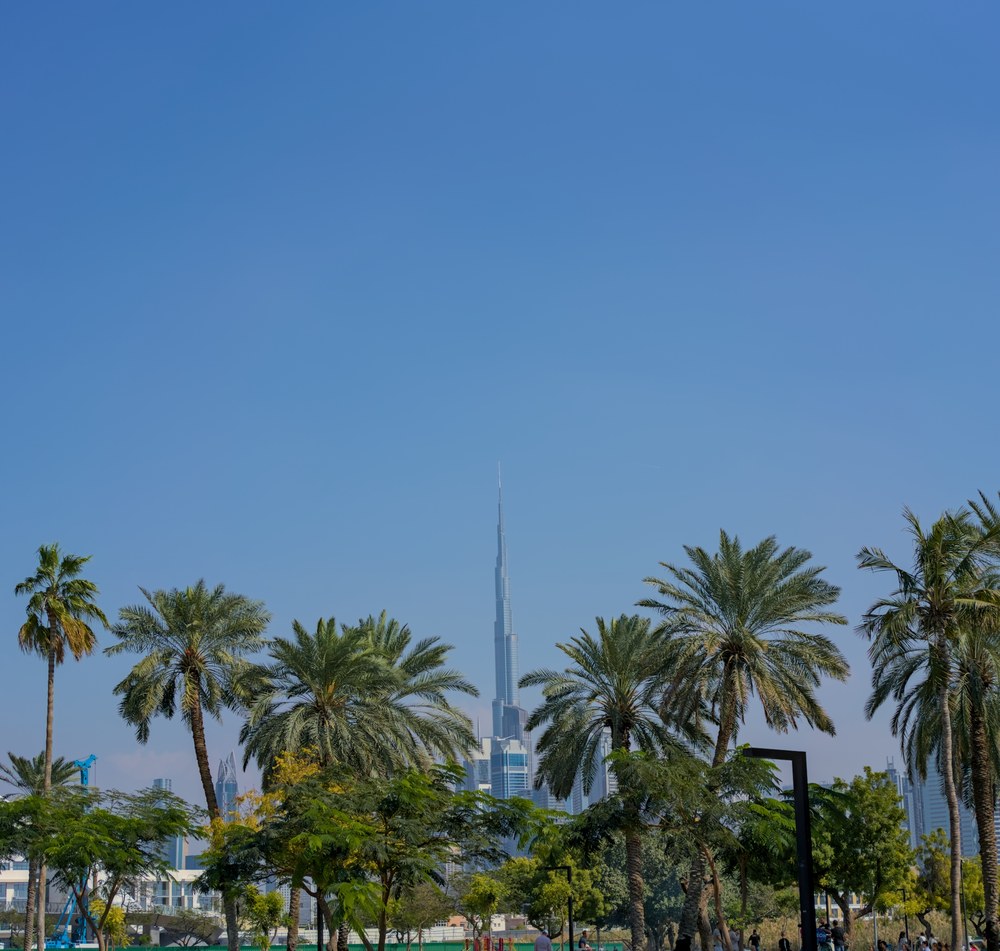 The tower from Safa Park: three wings on a central core, stepping back as they rise. Gfilip, CC BY-SA 4.0, via Wikimedia Commons
A desert flower in plan 2004
Skidmore, Owings & Merrill of Chicago performed the architecture and engineering, with Adrian Smith as chief architect and Bill Baker as chief structural engineer. The tower uses the bundled-tube design of SOM's Willis Tower, invented by Fazlur Rahman Khan. When Smith was conceiving the project he looked out of his office window toward Lake Point Tower's curved three-wing layout and thought, "There's the prototype." The result: a Y-shaped tripartite floor plan of three wings on a central buttressed core, with 27 setbacks in a spiral pattern that reduce the cross-section as the tower rises and minimize wind vibration. The central core houses all vertical transportation. The design is inspired by the Hymenocallis, a desert flower; the tiered, petal-like setbacks echo the flower's geometry, and the surrounding 11-hectare park is designed around it. The stepping, spiraling setbacks also recall the spiral minaret of the Great Mosque of Samarra, rooting the tower in the region's Islamic architecture.
The build and its human cost 2004-2009
Construction started on 6 January 2004. The main contractor was Samsung C&T of South Korea with BESIX of Belgium and Arabtec of the UAE; Turner was project manager; Hyder Consulting was supervising engineer and engineer of record. Over 35,000 tonnes of structural steel came from the demolished Palace of the Republic in East Berlin, the former East German parliament building, shipped to Dubai after its 2008 demolition. Putzmeister's super high-pressure pump set the 606 m concrete-delivery world record in May 2008. In total: 330,000 m3 of concrete, 55,000 tonnes of steel rebar, 22 million man-hours. The building labor force was primarily migrant workers from South Asia and East Asia. Press reports in 2006 put skilled carpenters' pay at 4.34 pounds a day and laborers' at 2.84 pounds, with BBC and Human Rights Watch reporting abysmal housing and confiscated passports. In March 2006 about 2,500 workers rioted over delayed buses, causing almost 500,000 pounds of damage.
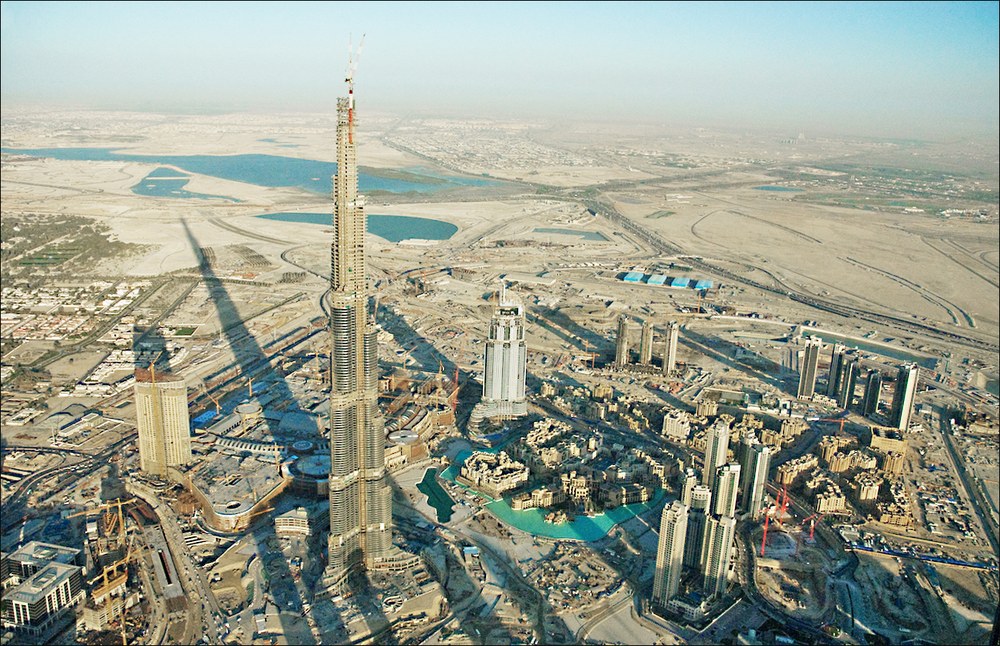 The tower under construction in 2008, already the tallest human-made structure ever built. Aheilner, CC BY-SA 4.0, via Wikimedia Commons
Record by record 2007-2009
During construction the tower surpassed, in order: the Sears Tower for most floors in February 2007, Taipei 101 on 21 July 2007 at 509.2 m, the Sears Tower antenna on 12 August 2007 at 527 m, the CN Tower as tallest freestanding structure on 12 September 2007 at 555.3 m, the KVLY-TV mast on 7 April 2008 at 629 m, and the Warsaw radio mast as tallest human-made structure ever built on 1 September 2008 at 688 m. It topped out at 829.8 m on 17 January 2009; the exterior was completed on 1 October 2009. On 10 March 2010 the Council on Tall Buildings and Urban Habitat certified it the world's tallest building.
The opening and the rename 2010
The official launch on 4 January 2010 featured 10,000 fireworks, light beams, and 6,000 guests. In a surprise move at the ceremony, the tower was renamed from Burj Dubai to Burj Khalifa in honor of UAE President Khalifa bin Zayed Al Nahyan. Dubai, mired in debt from the Great Recession, had received tens of billions of dollars in federal support arranged by the Abu Dhabi ruler, having borrowed at least 80 billion dollars for construction projects. The building's very name became a monument to the 2008-2009 bailout. Rents in the tower fell 40 percent within ten months of opening; 825 of 900 apartments stood empty. By October 2012 about 80 percent of apartments were occupied. The 304-room Armani Hotel, on floors 1 to 8 and 38 to 39, opened on 27 April 2010.
Vanity height and daredevils 2010-today
The spire's 242.5 m of structural steel houses communications equipment and is widely considered vanity height: without it the tower would be 585 m, and a CTBUH study noted the empty spire alone could stand as a skyscraper. Height has cultural side effects: on the higher floors the sun sets minutes later than at ground level, so residents above the 80th floor wait two extra minutes to break their Ramadan fast, and above the 150th floor three minutes. The program stacked into the height: At.mosphere, the world's highest restaurant, on the 122nd floor at 442 m; sky lobbies with swimming pools on the 43rd and 76th floors; At the Top on the 124th floor at 452 m, opened 5 January 2010; At the Top SKY on the 148th floor at 555 m, opened 15 October 2014; The Lounge observatory at 585 m across floors 152 to 154, opened 18 February 2019, also the world's highest lounge. The tower draws daredevils: Hervé Le Gallou and David McDonnell jumped unauthorised from below the 160th floor in May 2008; Nasr Al Niyadi and Omar Al Hegelan broke the world record for highest BASE jump from a building on 8 January 2010, leaping from 672 m; Vince Reffet and Fred Fugen broke the Guinness world record from the pinnacle at 828 m on 21 April 2014. On 28 March 2011 Alain "Spiderman" Robert scaled the outside of the tower to the top of the spire in 6 hours, with rope and harness per UAE safety laws. In January 2011 Tom Cruise performed the Burj Khalifa climb for Mission: Impossible - Ghost Protocol, rappelling on cables later digitally erased.
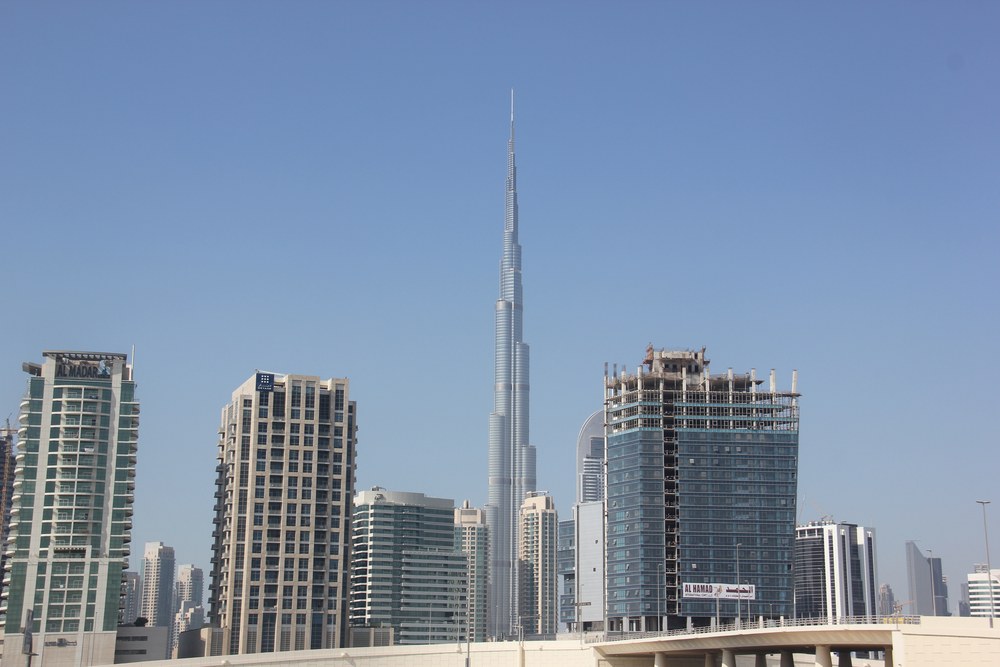 The full 829.8 m: 163 floors of Y-shaped plan beneath 242.5 m of spire. Laika ac, CC BY-SA 2.0, via Wikimedia Commons
The cleaning machine 2010-today
No structural restoration has been recorded. The building's maintenance system is itself a story: 24,348 windows totaling 120,000 m2 of glass; three 1,500 kg bucket machines on horizontal tracks; above level 109 traditional cradles; rope crews for the top; unmanned machines for the uppermost 27 tiers and the glass spire. The cleaning system was developed in Melbourne by CoxGomyl at a cost of A$8 million. Under normal conditions 36 workers take three to four months to clean the entire exterior.
In the cultural conversation 2011-2017
The tower's defining screen moment came in Mission: Impossible - Ghost Protocol (2011), when Ethan Hunt scales the outside of the building to reach a secure room, using prototype adhesive gloves that malfunction on the way down. Tom Cruise performed the climb for real, working at about 1,700 feet with a harness removed digitally, while director Brad Bird shot the sequence with IMAX cameras. The stunt fused the building into global pop culture within a year of its opening.
Hollywood has since treated the tower as its visual shorthand for Dubai, usually by destroying it. In Independence Day: Resurgence (2016) the alien mothership rips the tower out of the city and drops it on London, flattening the London Eye. In Geostorm (2017) a satellite-triggered tsunami taller than the tower slams into Dubai and the building buckles and collapses. The tower opened in 2010 and has no painting tradition; its fame lives on film and in the annual New Year's Eve broadcasts.
Bonus download: AI concept poster
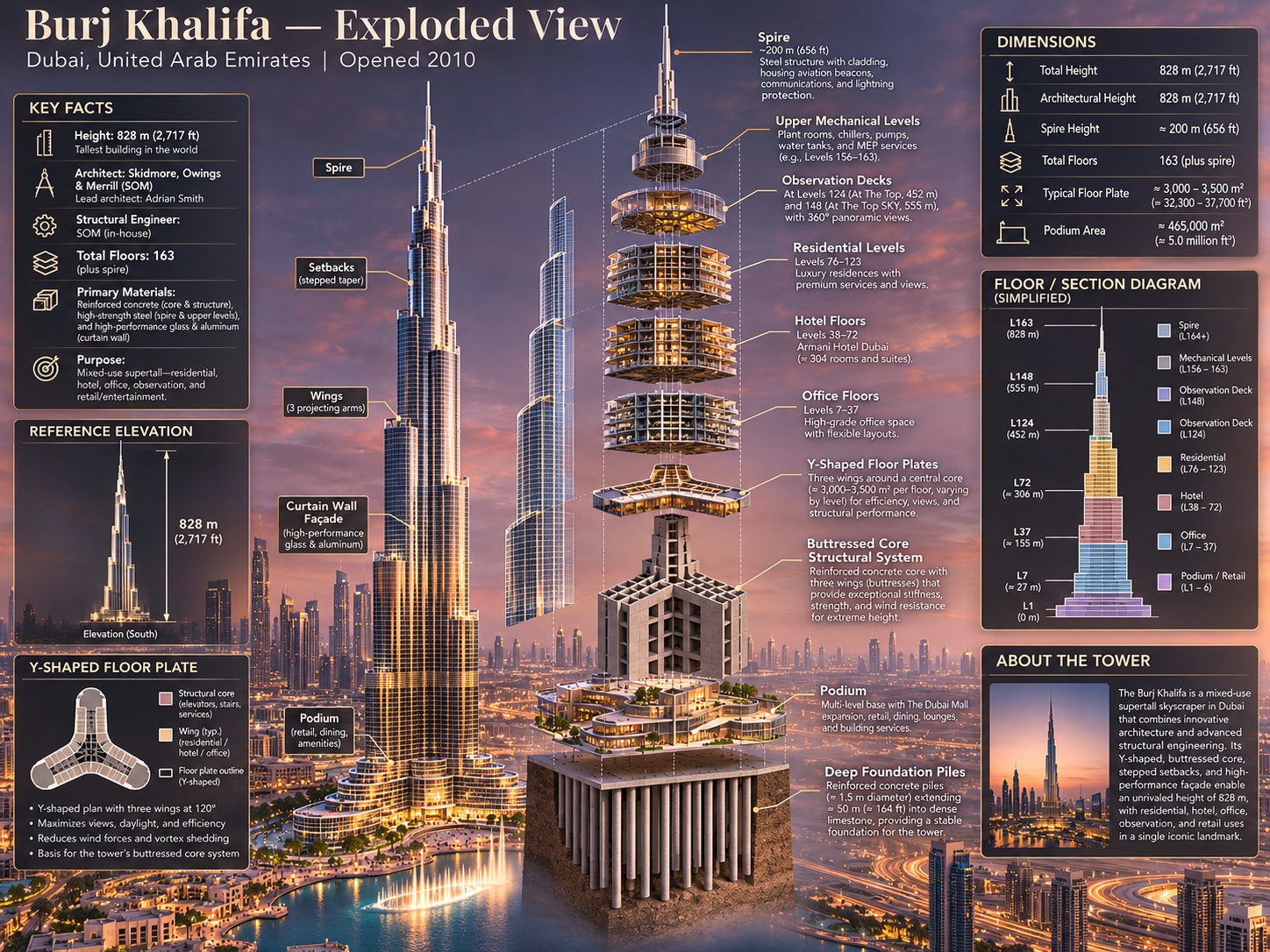 An AI-generated poster of the exploded Burj Khalifa (ChatGPT). An artistic impression, not the verified Atlas poster: the height reads 828 m here against 829.8 m in the Atlas story, and the spire reads about 200 m against 242.5 m in the story. The verified story is above.
Download the poster (JPG, 1448 x 1086)
Sources: Historical facts adapted from Wikipedia ("Burj Khalifa", CC BY-SA), the SOM technical report in Structural Engineering International 4/2015, and the geotechnical case study cited in the research brief. Cultural appearances verified against Wikipedia, BFI, museum collection pages, and production coverage.
Burj Khalifa full view against the sky: Laika ac, CC BY-SA 2.0, via Wikimedia Commons
Burj Khalifa seen from Safa Park: Gfilip, CC BY-SA 4.0, via Wikimedia Commons
Burj Khalifa under construction in 2008: Aheilner, CC BY-SA 4.0, via Wikimedia Commons