The story of the Brandenburg Gate
Berlin's most famous landmark is 26 meters of sandstone that has watched Prussian kings, Napoleon's army, Nazi rallies, and the fall of the Berlin Wall. This is how a city gate became the symbol of a reunited country.
A gate for peace 1788-1791
Commissioned by Frederick William II of Prussia and designed by Carl Gotthard Langhans, the gate was built between 1788 and 1791, modeled on the Propylaea of ancient Athens. Twelve Doric columns form five passageways through a structure 26 meters high and over 60 meters wide. It was first called the Friedenstor, the Peace Gate. In 1793 Johann Gottfried Schadow crowned it with the Quadriga: four horses pulling a chariot driven by the winged Victoria, goddess of victory, the first quadriga built since antiquity. The whole program carried one message, the absolutist's definition of peace: peace as the fruit of victorious arms.
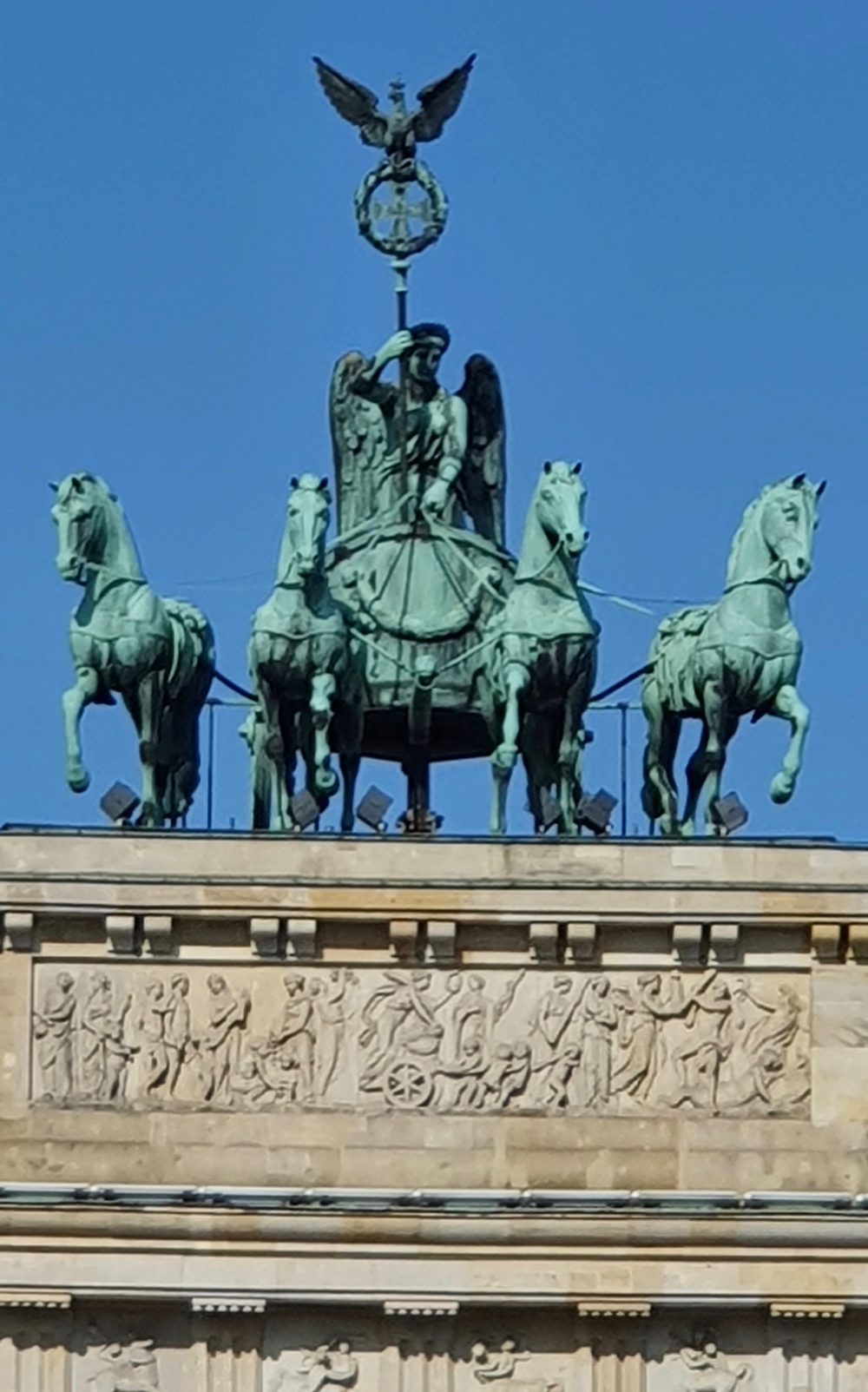 The Quadriga, sculpted by Johann Gottfried Schadow and installed in 1793. Yair Haklai, CC BY-SA 4.0, via Wikimedia Commons
Stolen, returned, rebranded 1806-1814
After Prussia's defeat at Jena-Auerstedt in 1806, Napoleon marched through the gate and carried the Quadriga off to Paris as a war trophy. When Napoleon fell, Prussian troops brought it home in 1814. For the occasion Karl Friedrich Schinkel reworked Victoria's standard: she received the Iron Cross crowned with the Prussian eagle, branding the victory as Prussia's.
Scarred by war 1939-1945
The Nazis adopted the gate as a party symbol and placed it on the axis of their planned world capital Germania. The war left it bullet-scarred; the Quadriga was destroyed, and only a single horse's head survived, now kept in the Märkisches Museum. When Soviet troops took Berlin in 1945, they raised the red banner of victory on the ruined Quadriga.
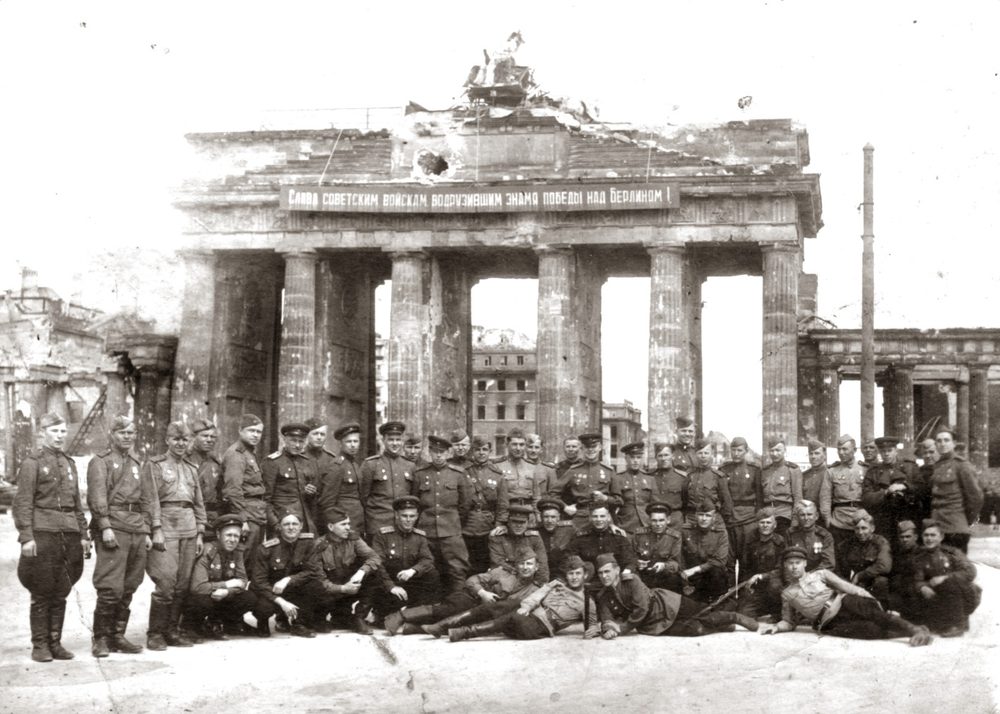 The gate in May 1945, with a Soviet victory banner on the ruined Quadriga. Alexey Shapochkin, CC BY-SA 4.0, via Wikimedia Commons
Twenty-eight years behind the Wall 1961-1989
When the Berlin Wall went up on 13 August 1961, it ran directly past the gate's western side. The gate stood in the death strip, unreachable from East and West alike, for 28 years. Two years after the Wall went up, John F. Kennedy came to Berlin. On 26 June 1963 he told 120,000 West Berliners at Rathaus Schöneberg: "Ich bin ein Berliner." During the same visit he looked out at the Brandenburg Gate from the West, while the Soviets hung red banners to block his view east. It was there, with the gate behind him, that Ronald Reagan demanded on 12 June 1987: Mr. Gorbachev, tear down this wall!
John F. Kennedy in West Berlin, 26 June 1963. Video: public domain via Wikimedia Commons.Transcript
Excerpt from the closing of the speech: "There are many people in the world who really don't understand, or say they don't, what is the great issue between the free world and the Communist world. Let them come to Berlin. There are some who say that communism is the wave of the future. Let them come to Berlin. And there are some who say in Europe and elsewhere we can work with the Communists. Let them come to Berlin. And there are even a few who say that it is true that communism is an evil system, but it permits us to make economic progress. Lass' sie nach Berlin kommen. Let them come to Berlin." Two thousand years ago, the proudest boast was "civis Romanus sum." Today, in the world of freedom, the proudest boast is "Ich bin ein Berliner!" All free men, wherever they may live, are citizens of Berlin, and therefore, as a free man, I take pride in the words "Ich bin ein Berliner!"
Transcript
"There is one sign the Soviets can make that would be unmistakable, that would advance dramatically the cause of freedom and peace. General Secretary Gorbachev, if you seek peace, if you seek prosperity for the Soviet Union and Eastern Europe, if you seek liberalization: Come here to this gate! Mr. Gorbachev, open this gate! Mr. Gorbachev, tear down this wall!"
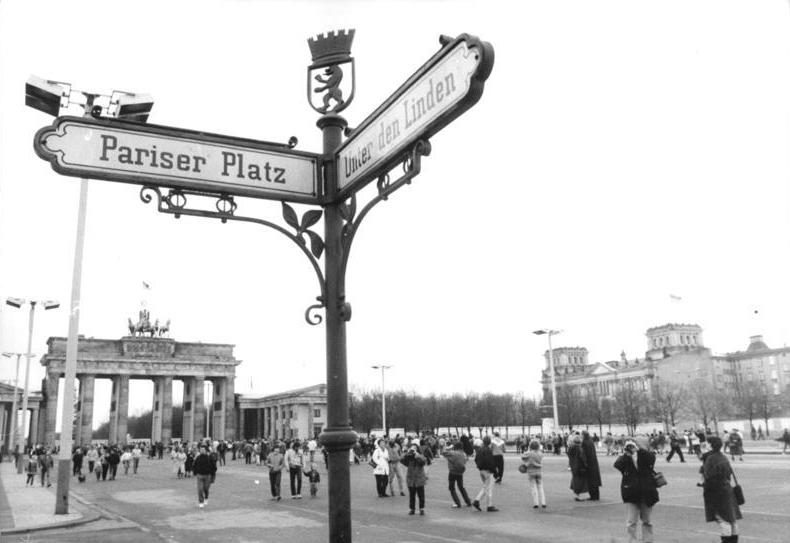 The border crossing at the gate the day after it reopened, 23 December 1989. Bundesarchiv, Bild 183-1989-1223-300 / CC-BY-SA 3.0, via Wikimedia Commons
The symbol of a reunited country 1989-today
On 9 November 1989 the Wall fell and thousands celebrated at the gate. On 22 December 1989 the crossing reopened, with Helmut Kohl walking through to meet Hans Modrow before a crowd of 100,000. The Quadriga was restored, the Iron Cross returned, and the gate itself was refurbished from 2000 to 2002. Today it is the symbol of reunified Germany: the finish line of the Berlin Marathon, the stage for New Year's Eve, and the first thing the world pictures when it thinks of Berlin. Weeks after the Wall fell, David Hasselhoff sang his summer number one 'Looking for Freedom' from a crane above the Wall on New Year's Eve, in a jacket sparkling with electric lights. The song had become a soundtrack for the Wall's fall.
Rebuilt from a plaster cast 1945-2002
The war left the gate pockmarked with bullets and shrapnel, and the Quadriga in ruins. A single horse's head survived, and it sits today in the Märkisches Museum. The Quadriga itself was saved by luck: a plaster cast made in 1942, three years before the destruction. In 1956, in a rare moment of East-West cooperation, sculptor Otto Schnitzer and the Hermann Noack foundry recreated the entire Quadriga from that cast. It was hoisted back on 14 December 1957, this time without the Iron Cross. After reunification the Quadriga came down again for renovation and the Iron Cross returned. From 2000 to 2002 the whole gate was restored for 6 million euros and reopened on 3 October 2002 with a new lighting concept. What you see today is a ruin that refused to stay one.
Sources: Historical facts adapted from Wikipedia ("Brandenburg Gate", CC BY-SA, including the German article's symbolism research), visitBerlin.de, and Encyclopaedia Britannica.
Gate at dusk: Thomas Wolf, www.foto-tw.de, CC BY-SA 3.0, via Wikimedia Commons
Quadriga close-up: Yair Haklai, CC BY-SA 4.0, via Wikimedia Commons
Gate in ruins, May 1945: Alexey Shapochkin, CC BY-SA 4.0, via Wikimedia Commons
Border crossing reopening, 23 December 1989: Bundesarchiv, Bild 183-1989-1223-300 / CC-BY-SA 3.0, via Wikimedia Commons